Exercício: Vocabulário de Natal

Hey guys! Merry Christmas!

Já falamos aqui no Blog sobre vocabulário de natal em inglês. Hoje vamos praticar um pouco. Assim, não vamos esquecer esse vocabulário até o próximo natal (just kidding!).

Para aprender (ou relembrar!), leia (ou releia!) esses textos aqui, e aqui.

merry-christmas-hd-images

Choose the best option to complete the sentences below:

1 – We usually stay home ________ Christmas Eve.

a) on      b) at

2 – My family is __________ Christmas Dinner on the 24th.

a) having      b) making

3 – What do you want ___________ Christmas?

a) on      b) for

4 – Where are you going to ___________ Christmas?

a) spend      b) pass

5 – Who’s your Secret ______________?

a) Friend      b) Santa

6 – Let’s attend ___________ mass!

a) Midnight      b) Cock

7 – I really wouldn’t like to get a gift ___________ for Christmas.

a) certificate      b) worth

Check your answers below!

1 – a; 2 – b; 3 – b; 4 – a; 5 – b; 6 – a; 7 – a

Based on Bruna Iubel  

https://blog.influx.com.br/2014/12/27/exercicio-vocabulario-de-natal-em-ingles/
Exercício: “at the end” or “in the end” 2017

Às vezes, expressões muito similares em inglês acabam por confundir os aprendizes no momento de utilizá-las. No caso de at the end e de in the end, os significados também são bem parecidos em português. Então, para sanar de vez todas as dúvidas, nada melhor do que praticar com um rápido exercício.

Antes de fazer o exercício, convém ler (ou reler) o post onde mostrei o uso de at the end in the end clicando aqui.

Fill in the gaps in the sentences below using “at the end” or “in the end”:

1. I’ll travel to New York __________________ of the year.

2. We will succeed __________________.

3. __________________ of the wedding party, the bride threw the bouquet.

4. All the students gave the teacher a hug __________________ of the class.

5. I’m sure that, __________________, things will be alright.

6. __________________, Michael Phelps won a gold medal again.

7. Michael Phelps won another gold medal __________________ of the competition.

8. He took her to eat out __________________ of the day.

9. __________________ of the course, his score was much more than 700 in the TOEIC Test.

The end

Ah, tenho certeza de que estes exercícios foram muito fáceis in the end! Vamos conferir seus acertos?

  1. at the end
  2. in the end
  3. at the end
  4. at the end
  5. in the end
  6. in the end
  7. at the end
  8. at the end
  9. at the end

Joyce Rodrigues  27/ago/2016  http://blog.influx.com.br/exercicio-quando-usar-at-the-end-e-in-the-end

Refresh 2017: many, much and a lot of

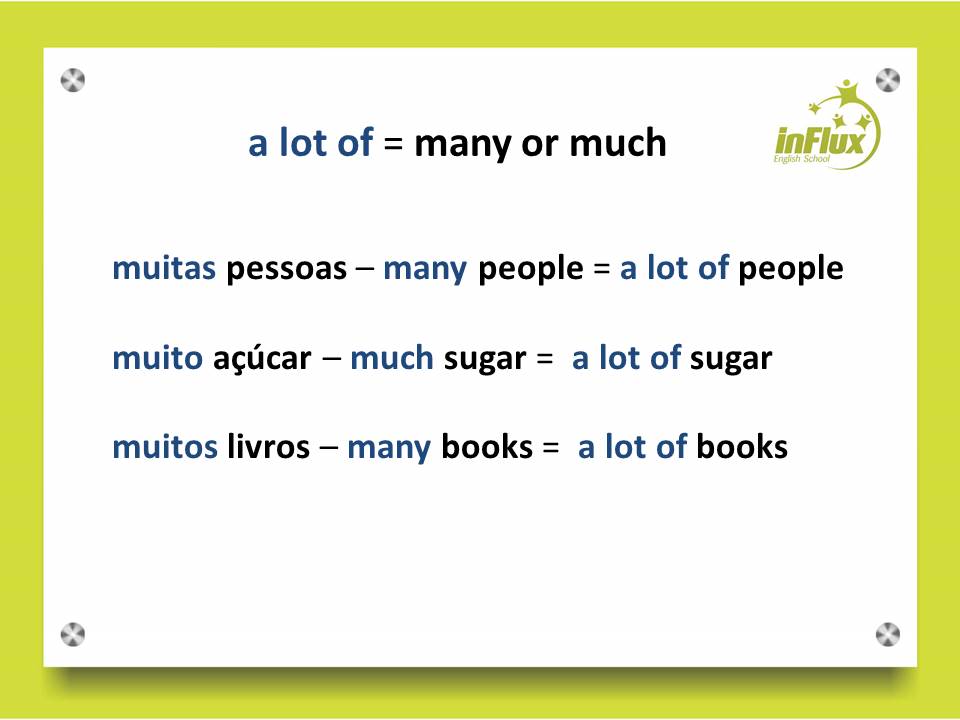
“Many”, “much” “a lot of” significam “muito(s)”“muita(s)”“bastante”. Vejam no quadro abaixo:

A lot of

Agora vamos ver alguns exemplos:

I have many books. Ou I have a lot of books.  Eu tenho muitos livros.

We don’t have much time. Ou We don’t have a lot of time.  Nós não temos muito tempo.

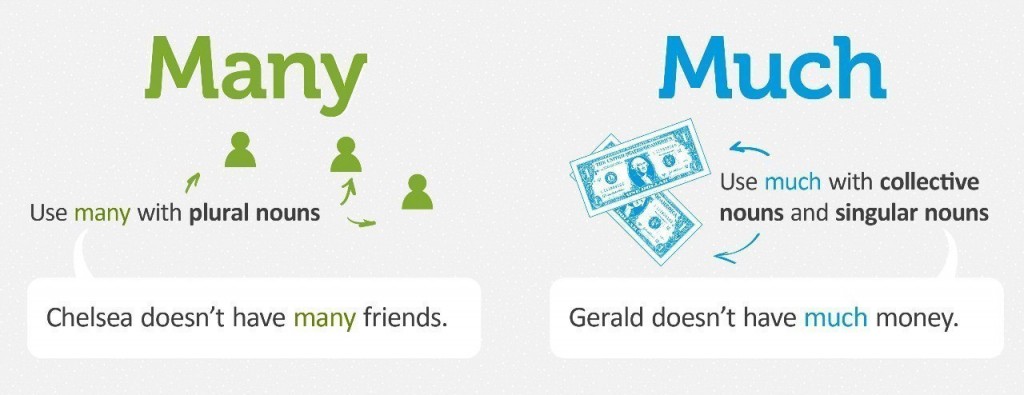
O significado é o mesmo, mas existe diferença quanto ao uso das expressões! “Many” e “much” são principalmente usadas em sentenças negativas ou interrogativas e são incomuns em sentenças afirmativas, sendo que “many” é usada com substantivos contáveis e “much” com substantivos incontáveis. Veja os exemplos:

I don’t have much money.  Eu não tenho muito dinheiro.

Do you have much money?  Você tem muito dinheiro?

She doesn’t have many friends.  Ela não tem muitos amigos.

Does she have many friends?   Ela tem muitos amigos?

many-much-1024x395

Nas sentenças afirmativas é muito mais comum usarmos “a lot of” ou sua forma mais informal: “lots of”. Vejam nas sentenças abaixo como ficariam com o uso de “a lot of”:

I have a lot of money ou I have lots of money.  Eu tenho muito dinheiro.

She has a lot of friends ou She has lots of friends.  Ela tem muitos amigos.

Vamos ao exercício?

1. There are ____________ books about English Learning in this store.

2. I don’t have ____________ homework to do.

3. ____________ students have doubts about the words “much” and “many”.

4. There were ____________ cars in the parking lot near the store.

5. I don’t drink ____________ milk in the morning.

6. There are ____________ apples on the kitchen table.

Procurem criar algumas sentenças usando estas expressões, e confiram as respostas do exercício aqui http://www.influx.com.br/blog/2011/11/27/quando-usar-many-e-much-respostas-exercicios-para-treinar-o-ingles/

Baseado em Denilso de Lima e Livia Bacan at: http://www.influx.com.br/blog/2009/03/12/many-much-e-a-lot-of/#sthash.IaLjzpvV.dpufehttp://www.influx.com.br/blog/2009/03/11/many-ou-much-e-agora/#sthash.JKKGvAot.dpufhttp://www.influx.com.br/blog/2011/11/26/quando-usar-many-e-much-exercicios-para-treinar-o-ingles/#sthash.YsrYWGME.dpuf

Exercício: Como pedir desculpas em inglês!

Você pôde aprender aqui no Blog diferentes maneiras de perdoar e também se desculpar em inglês. Leia (ou releia) o post aqui!

E agora vamos praticar seus conhecimentos sobre o assunto?

sorry-img1-dest

Match the sentences in Portuguese with their respective equivalence in English:

1. Estou me sentindo mal pelas coisas que disse ontem.

2. Espero que você possa me perdoar!

3. Sinto muito, não tive a intenção de te magoar.

4. Me perdoe por ter feito isso!

5. Ela nunca vai perdoá-lo por tê-la traído!

6. Peço mil desculpas por ter dito essas coisas!

7. Peço desculpas por ter sido grosseiro com você.

8. Ela se desculpou por ter saído sem avisá-lo.


( ) She’ll never forgive him for cheating on her!

( ) I’m very sorry, I didn’t mean to hurt you.

( ) I apologize for being rude to you.

( ) She apologized for leaving without telling him.

( ) I hope you can forgive me!

( ) I feel really bad for the things I said yesterday.

( ) Forgive me for doing that!

( ) I do apologize for saying those things!

I apologize 2

Check your answers: 5 – 3 – 7 – 8 – 2 – 1 – 4 – 6

Based on Thiago Tasep  

Exercises: “else”

O exercício de hoje é sobre o uso correto da palavra “else”, que pode significar “mais” e “outro(a)/outros(as)”, dependendo das palavras com as quais ela se combina. Para aprender sobre ela, não deixe de ler esse post aqui.

Now, fill in the gaps using the expressions from the board:

Else-quadro

1) A: _______________ was there? (Quem mais estava lá?)

     B: John and Nancy.

2) A: _______________ do you want? (O que mais você quer?)

     B: If you can bring eggs and cookies, that’ll help.

3) Before we do _______________, we must sit down and make a list. (Antes de fazer qualquer outra coisa, nós precisamos sentar e fazer uma lista.)

4) I think we should ask _______________ to do it. (Acho que a gente deve pedir para outra pessoa fazer isso.)

5) If it doesn’t work, try ______________. (Se não funcionar, tente outra coisa.)

6) You won’t find it _______________ in the world. (Você não vai encontrar isso em nenhum outro lugar do mundo.)

7) We went out for a snack and ______________. (Nós saímos para um lance e não mais que isso.)

8) I’ve looked all over – there’s _______________ my wallet could be! (Olhei por tudo – não tem mais nenhum lugar que a minha carteira pode estar!)

else-img1Check your answers below:

1) Who else
2) What else
3) anything else
4) somebody else
5) something else
6) anywhere else
7) not much else
8) nowhere else

 http://blog.influx.com.br/exercicio-como-usar-a-palavra-else-corretamente


Enjoy your Saturday!