
What Are Phrasal Verbs?
Phrasal verbs are a verb + one or more particles (prepositions or adverbs) that create a new meaning.
Example: get over = recover or overcome (not “get” + “over” literally).
They are very common in spoken English and often unpredictable.
Types of Phrasal Verbs
1. Two-Part Verbs
Verb + one particle
Examples:
- grow up – The children are growing up.
- take after – She takes after her mother. (= She looks like her mother or she behaves like her mother.)
- count on – I can count on you. (= I know I can trust you or I know I can believe you.)
a) Inseparable
Verb and particle cannot be split.
She takes after her mother.
b) Separable
With a noun object, you may place the particle before or after the object:
She gave back the money. / She gave the money back.
But with a pronoun, separation is required:
She gave it back. ✅
She gave back it. ❌
Common separable particles: apart, around, away, back, behind, down, out, over, together, off, up.
2. Three-Part Verbs
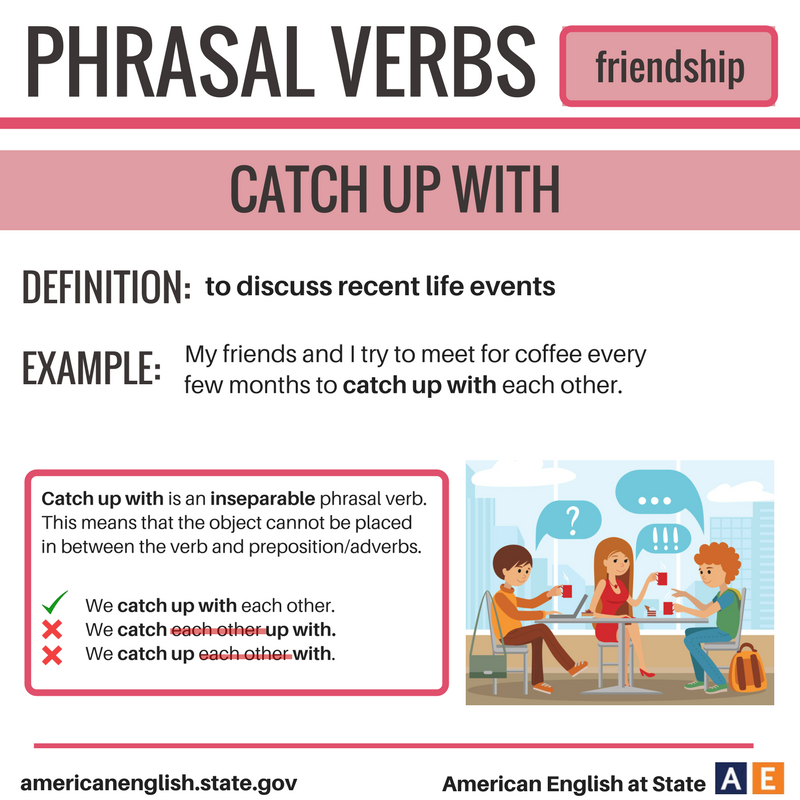
Verb + two particles, always inseparable:
- walk out on – His girlfriend walked out on him.
- catch up with – She caught up with the runners.
- look up to – Children should look up to their parents.
Grammar & Tenses
Only the verb changes form; the particles stay the same.
- Past: I got over the flu.
- Infinitive: I need to get over this cold.
- Gerund: I’m getting over the flu.
Key takeaway:
A phrasal verb acts as one unit of meaning, so learn them as phrases, not word by word.
Practice
Test your knowledge of phrasal verbs with these online exercises.
Keep Learning
Want more? Watch the video for more phrasal verbs.