We all know that it’s polite to say “Thank you” when someone does something kind or helpful for us.
And when you’re learning English, expressions such as “please,” “thank you,” “sorry,” and “excuse me” are essential for sounding natural and communicating politely.
But what should you say when someone thanks you?
Of course, you can always say:
“You’re welcome.”
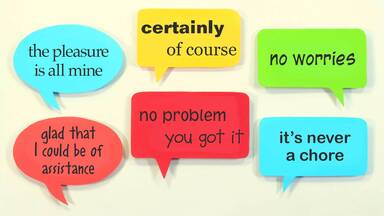
But there are many other natural ways to respond to “Thank you”, and the best expression depends on the situation and the relationship between the speakers.
Let’s take a look!
1. “You’re welcome” — the classic response
“You’re welcome” is the standard response to “Thank you.”
It is polite, natural, and appropriate in almost any situation.
For example:
A: Thank you for your help.
B: You’re welcome!
A: Thanks for the coffee.
B: You’re welcome!
So, there is absolutely nothing wrong with saying “You’re welcome.”
However, if you want to sound more flexible and natural in everyday conversations, it’s useful to know some other expressions too.
2. Other natural ways to respond
There are many alternatives to “You’re welcome.” Some are more casual, while others are particularly useful in professional or polite situations.
😊 Friendly & informal
These expressions are very common in everyday conversations:
- No problem!
- No worries!
- Don’t worry about it!
- Don’t mention it!
- Anytime!
- Sure!
- Sure thing!
- It was nothing!
- You’re so welcome!
For example:
A: Thanks for helping me with my bags.
B: No problem!
A: Thanks for picking me up at the airport.
B: Anytime!
A: Thank you so much!
B: You’re so welcome!
💡 Tip: These expressions are generally more casual and friendly than “You’re welcome.”
🤝 Polite & professional
These are especially useful at work or when you want to sound warm and polite:
- My pleasure.
- It was my pleasure.
- Happy to help.
- I’m happy to help.
- I’m glad I could help.
- You’re very welcome.
For example:
A: Thank you for helping me with this report.
B: My pleasure.
A: Thanks for your help today.
B: Happy to help!
A: Thank you very much for your time.
B: You’re very welcome.
💡 My pleasure is a particularly useful expression to learn. It communicates that you were happy to help, rather than simply saying that the other person doesn’t need to thank you.
3. Watch & notice
Now let’s see some of these expressions in real conversations.
🎬 Video 1 — Different ways to say “You’re welcome”
First, watch the video without English subtitles. Try to identify the different expressions people use to respond to “Thank you.” Then watch it again with subtitles if you need some extra support.
🎬 Video 2 — More expressions
In this video, pay attention to the last two responses from Bob.
What expressions does he use?
4. Which expression should you use?
You don’t need to memorize every possible response.
Here are some of the most useful ones to start using:
| Expression | Typical use |
|---|---|
| You’re welcome. | Neutral / standard |
| No problem. | Informal / everyday |
| No worries. | Informal / friendly |
| My pleasure. | Polite / professional |
| Happy to help. | Friendly / professional |
| Anytime! | Friendly / informal |
| Don’t mention it. | Friendly / slightly old-fashioned |
| You’re so welcome! | Very friendly / enthusiastic |
💡 My advice: Start with “You’re welcome,” “No problem,” “My pleasure,” and “Happy to help.” These four will already give you plenty of variety.
5. Quiz time! 📝
🎬 Video 3 — Practice
Now it’s time to test what you’ve learned. Take the quiz and see how many expressions you can recognize and understand.
6. Now it’s your turn!
Knowing an expression is one thing. Using it in a real conversation is another!
Choose the response that sounds most natural to you in each situation.
1.
Your colleague helps you carry some boxes.
“Thanks for helping me!”
→ __________________________
2.
A friend thanks you for driving them home.
“Thank you for the ride!”
→ __________________________
3.
A client thanks you for your help with a project.
“Thank you very much for your help.”
→ __________________________
4.
Someone thanks you for holding the door open.
“Thanks!”
→ __________________________
5.
A friend thanks you enthusiastically for a big favor.
“Thank you so much! You really helped me.”
→ __________________________
Possible answers
There isn’t always only one correct answer. It depends on the situation and your relationship with the person.
- No problem! / Happy to help!
- You’re welcome! / Anytime!
- My pleasure. / You’re very welcome.
- No problem! / You’re welcome!
- You’re so welcome! / My pleasure!
7. And one more thing…
Sometimes, you’ll hear something a little unexpected:
“Thank YOU!”
Why would someone say “Thank YOU!” after you have just thanked them?
Because sometimes both people have something to be thankful for.
For example:
A: Thanks for coming to my party!
B: Thank YOU for inviting me!
Or:
A: Thank you for helping me with my presentation.
B: Thank YOU for giving me the opportunity to be part of it!
The emphasis on YOU changes the meaning.
It can mean:
“No, I should be thanking you!”
🎬 Video 4 — “Thank YOU!”
Watch the video below and see how this expression is used.
⭐ Your takeaway
You don’t always have to say “You’re welcome.”
Next time someone says “Thank you,” try choosing a response that fits the situation:
Neutral:
→ You’re welcome.
Friendly:
→ No problem! / No worries! / Anytime!
Professional:
→ My pleasure. / Happy to help.
Warm & enthusiastic:
→ You’re so welcome!
And remember:
The goal isn’t to memorize every expression. It’s to learn a few that you can actually use.
So… next time someone says “Thank you!”, what will you say? 😊