
What time is it?
Knowing how to tell the time is an essential part of everyday communication. Let’s learn how to ask for and tell the time naturally in English!
1. ASKING FOR THE TIME
Here are the most common ways to ask someone what time it is:
- What time is it?
- What’s the time?
- Do you have the time? (polite and conversational)
To answer, you can say:
- It’s nine o’clock.
- It’s 9:30.
- It’s almost ten.
2. TELLING THE TIME – THE BASICS
In everyday American English, you can simply read the hour followed by the minutes.
| Time | How to say it |
|---|---|
| 7:00 | Seven o’clock |
| 8:05 | Eight oh five |
| 9:10 | Nine ten |
| 10:15 | Ten fifteen |
| 11:20 | Eleven twenty |
| 12:30 | Twelve thirty |
| 2:45 | Two forty-five |
| 4:50 | Four fifty |
IMPORTANT: When the minutes are between 01 and 09, we say OH instead of zero.
Examples:
- 9:05 – Nine oh five.
- 10:03 – Ten oh three.
- 11:07 – Eleven oh seven.
3. O’CLOCK, A.M. AND P.M.
O’CLOCK
We use o’clock when the time is exactly on the hour.
- 6:00 – Six o’clock.
- 9:00 – Nine o’clock.
- 12:00 – Twelve o’clock.
A.M. AND P.M.
- A.M. – From midnight until before noon.
- P.M. – From noon until before midnight.
Examples:
- 7:00 a.m. – Seven a.m. (in the morning).
- 2:00 p.m. – Two p.m. (in the afternoon).
- 8:00 p.m. – Eight p.m. (in the evening).
- 12:00 a.m. – Midnight.
- 12:00 p.m. – Noon.
You can also add the period of the day instead of saying a.m. or p.m.
LANGUAGE TIP: DIGITAL TIME VS. TRADITIONAL TIME
There are two common ways to tell the time in English.
1. DIGITAL TIME
Simply read the hour followed by the minutes.
- 9:05 – Nine oh five.
- 3:15 – Three fifteen.
- 4:30 – Four thirty.
- 5:45 – Five forty-five.
This is the easiest and most natural way to tell the time in everyday American conversations.
2. TRADITIONAL TIME – Using PAST and TO
You can also use past and to to express the minutes before or after an hour.
- 9:05 – Five past nine.
- 3:15 – A quarter past three.
- 4:30 – Half past four.
- 5:45 – A quarter to six.
Compare:
“What time is it?”
“It’s nine oh five.”
“It’s five past nine.”
Both answers are perfectly correct!
4. QUARTER AND HALF
English also has traditional expressions for telling the time.
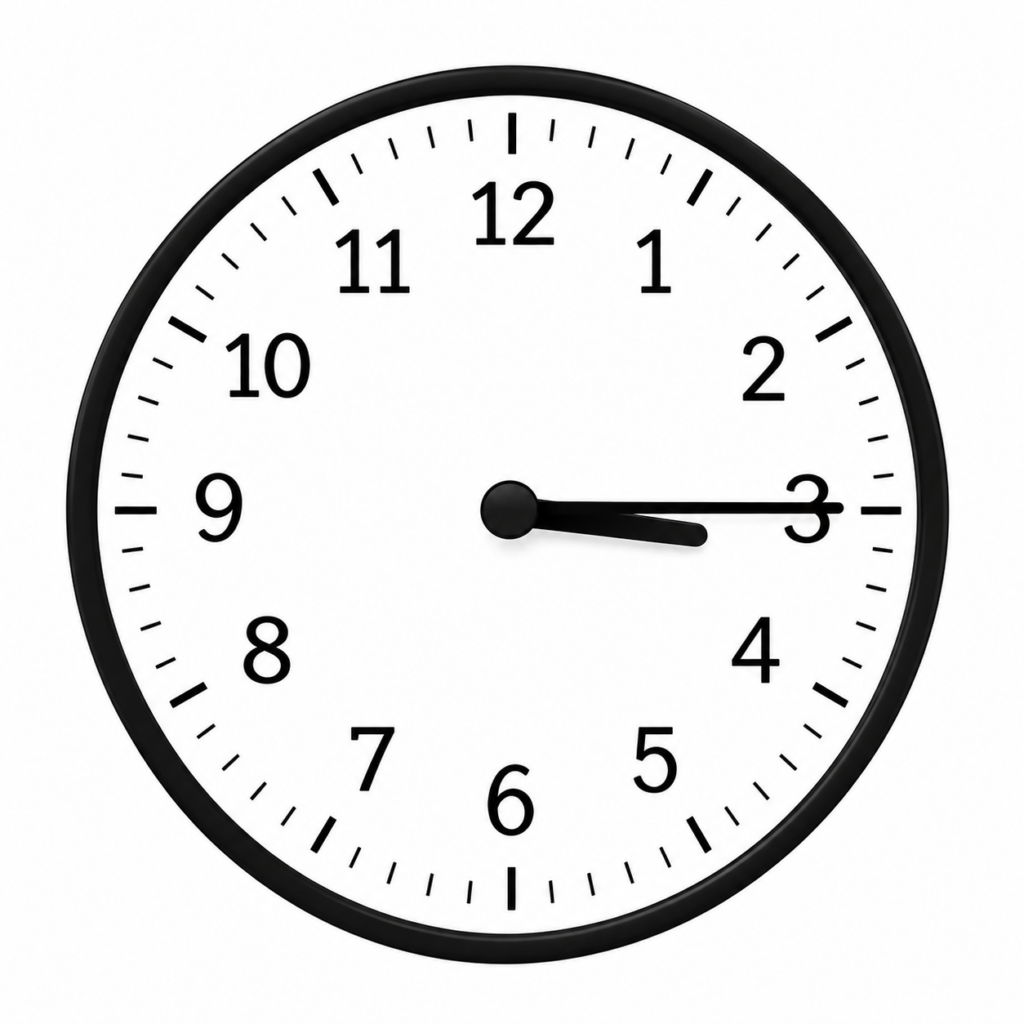
- Quarter past = 15 minutes after the hour.
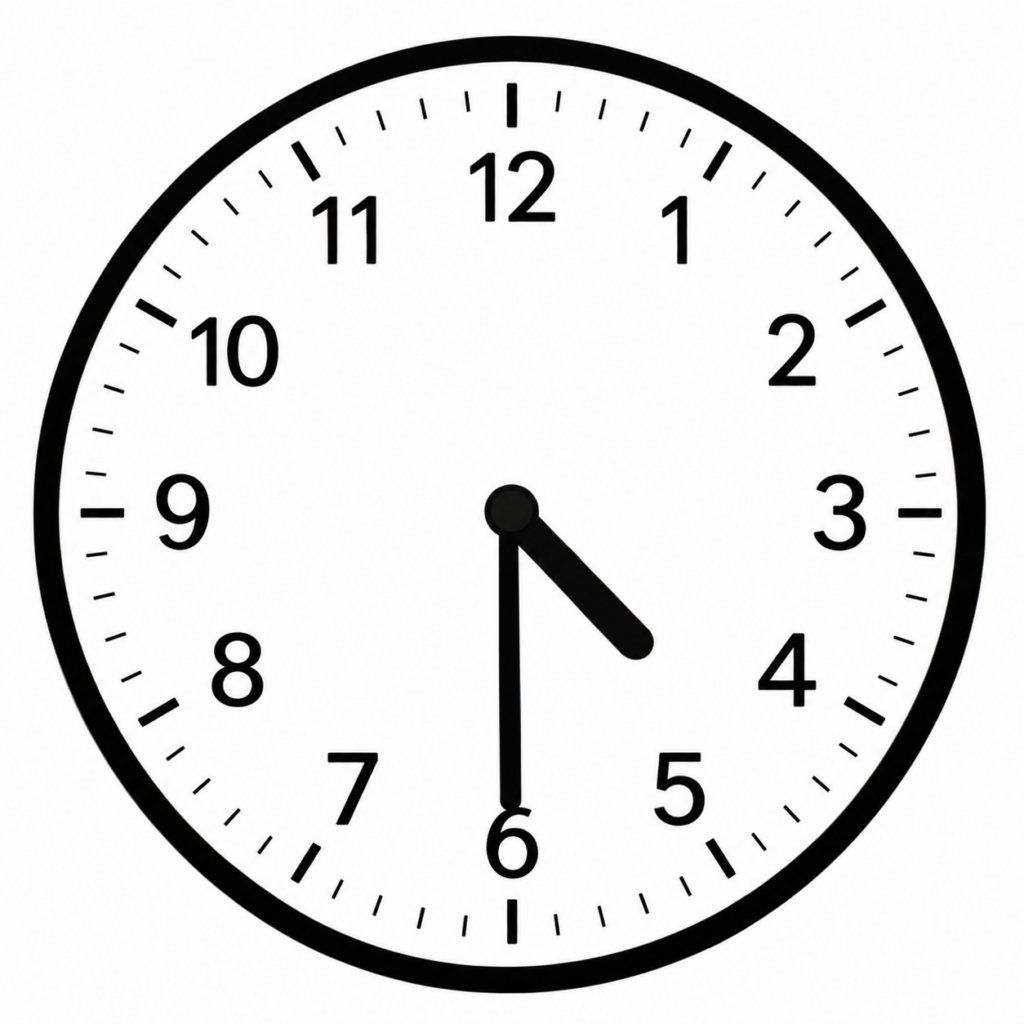
- Half past = 30 minutes after the hour.
- Quarter to = 15 minutes before the next hour.
Examples:
- 3:15 – A quarter past three.
- 4:30 – Half past four.
- 5:45 – A quarter to six.
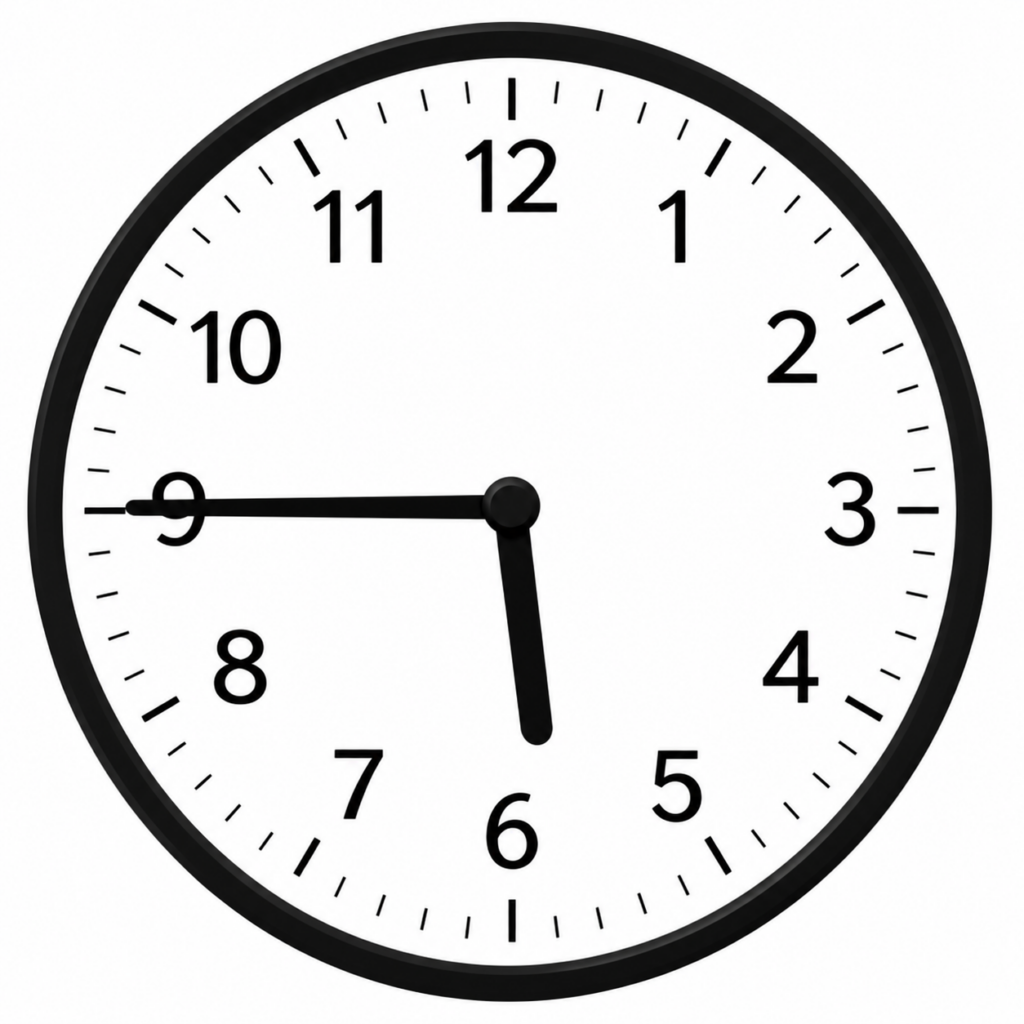
Notice that quarter to six means 5:45, not 6:45!
5. PAST AND TO
We can also use past and to to tell the time.
PAST – Minutes after the hour.
- 2:10 – Ten past two.
- 3:20 – Twenty past three.
- 7:25 – Twenty-five past seven.
TO – Minutes before the next hour.
- 4:50 – Ten to five.
- 6:40 – Twenty to seven.
- 8:55 – Five to nine.
A useful tip: In everyday American English, reading the numbers directly (six forty, eight fifty-five) is extremely common. The past and to structures are also correct and useful to understand.
6. USEFUL EXPRESSIONS
Here are some expressions you will hear in everyday conversations:
- It’s exactly nine. – São exatamente nove horas.
- It’s almost ten. – São quase dez.
- It’s just after eight. – Acabou de passar das oito.
- It’s around noon. – É por volta do meio-dia.
- I’m running late. – Estou atrasado(a).
- I’m right on time. – Estou exatamente no horário.
- I’m five minutes early. – Cheguei cinco minutos antes.
- I’m five minutes late. – Estou cinco minutos atrasado(a).
7. TALKING ABOUT YOUR SCHEDULE
When talking about schedules, use AT before the time.
Examples:
- My class starts at 9 a.m.
- I wake up at 6:30.
- The meeting is at 2:15 p.m.
- Dinner is at 8 o’clock.
Compare:
- What time is it? – Asking about the current time.
- What time does your class start? – Asking about a scheduled event.
8. LET’S PRACTICE!
How would you say these times in English?
- 7:05 a.m.
- 9:15 a.m.
- 10:30 a.m.
- 12:45 p.m.
- 3:20 p.m.
- 5:50 p.m.
- 8:08 p.m.
- 11:55 p.m.
CHALLENGE: Answer these questions using complete sentences.
- What time do you usually wake up?
- What time do you start working or studying?
- What time do you usually have lunch?
- What time do you go to bed?
Remember: Practice makes perfect!