
Knowing how to tell the time is an essential part of everyday communication. Let’s learn how to ask for and tell the time naturally in English!
1. ASKING FOR THE TIME
Here are three common ways to ask someone what time it is:
- What time is it? – The most common and direct way.
- What’s the time? – Another natural way to ask.
- Do you have the time? – A polite, conversational expression.
You can answer in different ways, depending on the situation:
- It’s nine o’clock.
- It’s 9:30.
- It’s almost ten.
2. TELLING THE TIME: THE DIGITAL WAY
One of the easiest and most common ways to tell the time in everyday English, is simply to read the numbers: hour + minutes.
| Time | How to say it |
|---|---|
| 7:00 | Seven o’clock |
| 8:05 | Eight oh five |
| 9:10 | Nine ten |
| 10:15 | Ten fifteen |
| 11:20 | Eleven twenty |
| 12:30 | Twelve thirty |
| 2:45 | Two forty-five |
| 4:50 | Four fifty |
Pronunciation tip:
When the minutes are between 01 and 09, we pronounce the zero as OH, just like the letter O.
- 9:05 – Nine oh five.
- 10:03 – Ten oh three.
- 11:07 – Eleven oh seven.
Notice that we don’t normally say zero five or zero three when telling the time this way.
3. O’CLOCK, A.M. AND P.M.
O’CLOCK
We use o’clock when the time is exactly on the hour, with no additional minutes.
- 6:00 – Six o’clock.
- 9:00 – Nine o’clock.
- 12:00 – Twelve o’clock.
We don’t use o’clock when minutes are included. For example, we say nine fifteen, not nine fifteen o’clock.
A.M. AND P.M.
In English, especially in the 12-hour clock system, we use a.m. and p.m. to distinguish between morning and afternoon/evening.
- A.M. – From midnight until before noon.
- P.M. – From noon until before midnight.
You can also use expressions indicating the period of the day instead of a.m. or p.m.:
- In the morning
- In the afternoon
- In the evening
- At night
- I wake up at seven in the morning.
- The meeting starts at two in the afternoon.
- I usually go to bed at eleven at night.
- 7:00 a.m. – Seven a.m. (in the morning).
- 2:00 p.m. – Two p.m. (in the afternoon).
- 8:00 p.m. – Eight p.m. (in the evening).
- 12:00 a.m. – Midnight.
- 12:00 p.m. – Noon.
4. THE TRADITIONAL WAY: PAST AND TO
Besides reading the numbers directly, English has another traditional way of telling the time. It uses the words past and to.
The key is to remember whether you’re referring to minutes after the current hour or minutes remaining until the next hour.
PAST = Minutes after the hour
We use past when referring to minutes that have already passed since the beginning of the hour.
- 2:10 – Ten past two.
- 3:20 – Twenty past three.
- 7:25 – Twenty-five past seven.
TO = Minutes before the next hour
We use to when referring to how many minutes remain before the next hour.
- 4:50 – Ten to five.
- 6:40 – Twenty to seven.
- 8:55 – Five to nine.
Important: With to, we mention the NEXT hour, not the current one!
QUARTER AND HALF
There are three particularly useful expressions in this traditional system:
- A quarter past = 15 minutes after the hour.
- Half past = 30 minutes after the hour.
- A quarter to = 15 minutes before the next hour.
Examples:
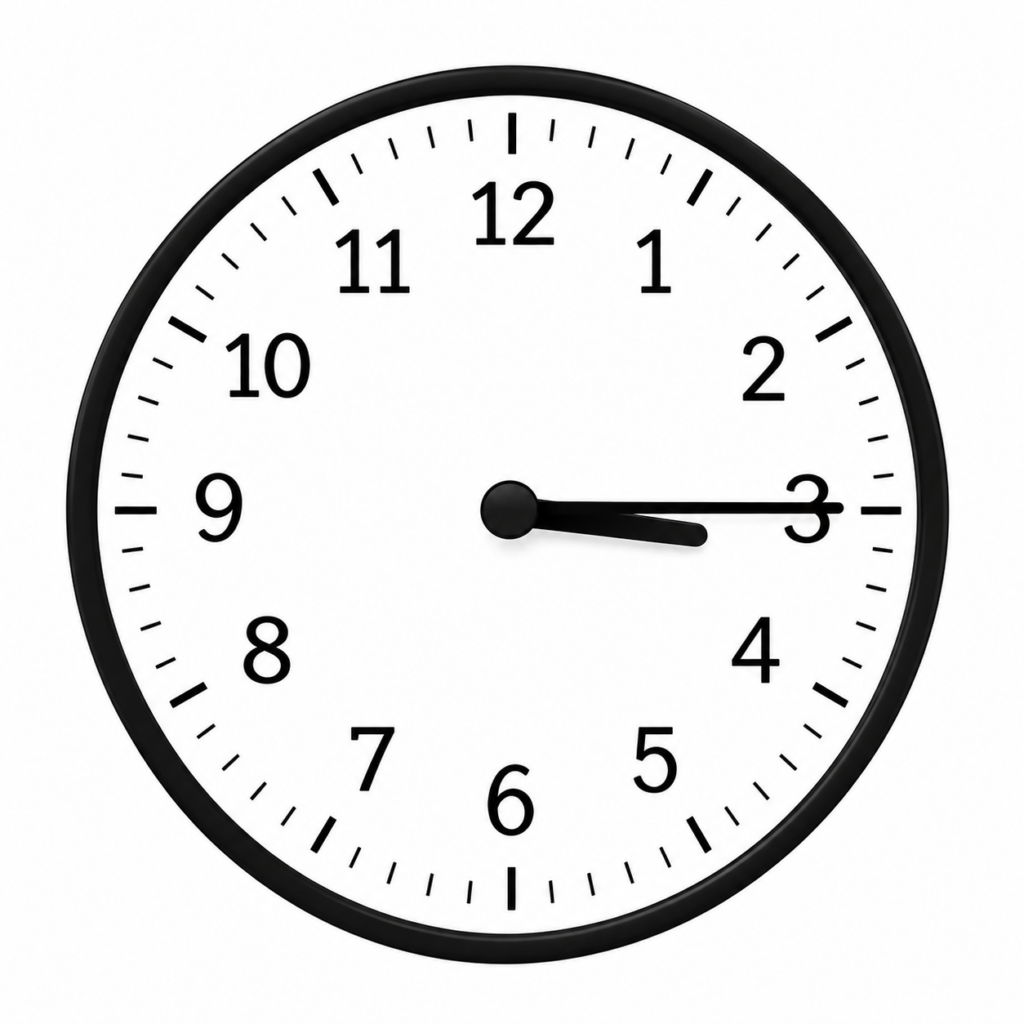
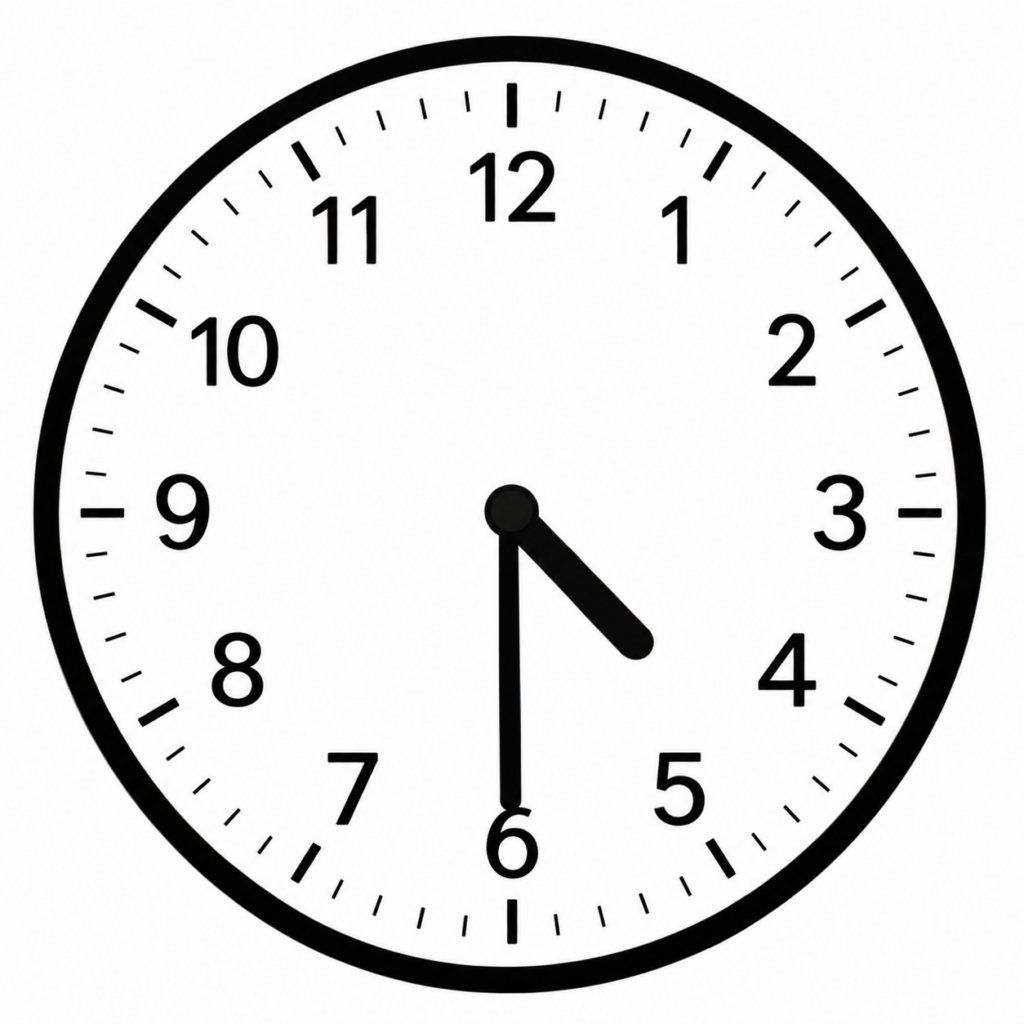
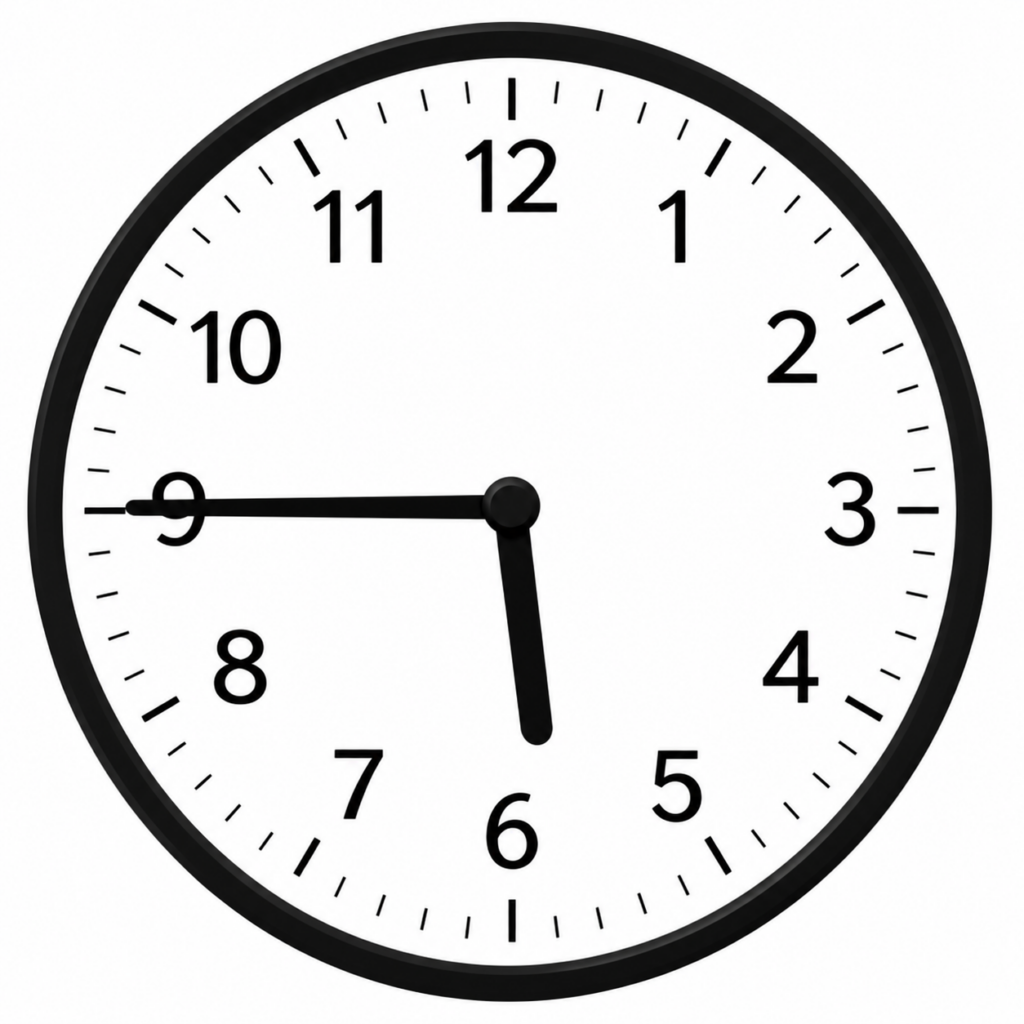
Watch out! A quarter to six means 5:45, not 6:45. We always refer to the next hour when using to.
DIGITAL VS. TRADITIONAL: WHICH ONE SHOULD YOU USE?
Let’s compare the two ways:
| Digital time | Traditional time |
|---|---|
| 9:05 – Nine oh five | Five past nine |
| 3:15 – Three fifteen | A quarter past three |
| 4:30 – Four thirty | Half past four |
| 5:45 – Five forty-five | A quarter to six |
Both forms are perfectly correct!
Reading the numbers directly is particularly common and practical in everyday English. The traditional form is also widely understood and useful, especially when listening to different English speakers.
5. USEFUL EXPRESSIONS FOR EVERYDAY CONVERSATIONS
Knowing how to read the clock is just the beginning. Here are some expressions that will help you talk about time more naturally.
Talking about the time
- It’s exactly nine. – São exatamente nove horas.
- It’s almost ten. – São quase dez.
- It’s just after eight. – Acabou de passar das oito.
- It’s around noon. – É por volta do meio-dia.
Being early, late or on time
- I’m running late. – Estou atrasado(a).
- I’m right on time. – Estou exatamente no horário.
- I’m five minutes early. – Cheguei cinco minutos antes.
- I’m five minutes late. – Estou cinco minutos atrasado(a).
6. TALKING ABOUT YOUR SCHEDULE: USING AT
When talking about schedules, appointments and daily routines, we use the preposition AT before a specific time.
- My class starts at 9 a.m.
- I wake up at 6:30.
- The meeting is at 2:15 p.m.
- Dinner is at eight o’clock.
Remember: we use at when referring to a specific time.
Compare:
- I wake up at seven.
- I wake up in the morning.
We use at with a specific time, but in with periods such as the morning and the afternoon. We say at night.
7. LET’S PRACTICE!
EXERCISE 1 – SAY THE TIME
Write each time in English. You can use either the digital or the traditional way whenever appropriate.
- 7:05 a.m.
- 9:15 a.m.
- 10:30 a.m.
- 12:45 p.m.
- 3:20 p.m.
- 5:50 p.m.
- 8:08 p.m.
- 11:55 p.m.
EXERCISE 2 – COMPLETE THE SENTENCES
Fill in the blanks with past, to, quarter, or half.
- 2:10 – Ten ______ two.
- 3:15 – A ______ past three.
- 4:30 – ______ past four.
- 5:45 – A quarter ______ six.
- 7:25 – Twenty-five ______ seven.
- 8:55 – Five ______ nine.
EXERCISE 3 – CORRECT THE MISTAKES
Each sentence contains a mistake. Rewrite it correctly.
- It’s five past to nine.
- It’s a half past four.
- It’s quarter past three.
- I wake up in 6:30.
- It’s a quarter to five. (The intended time is 4:45.)
EXERCISE 4 – TALK ABOUT YOUR ROUTINE
Answer the following questions using complete sentences.
- What time do you usually wake up?
- What time do you start working or studying?
- What time do you usually have lunch?
- What time do you finish work or studying?
- What time do you usually have dinner?
- What time do you go to bed?
CHALLENGE: Imagine you’re arranging a meeting with a friend. Suggest three different times and explain which one works best for you.
Remember: The more you practice, the more naturally you’ll talk about time in English!