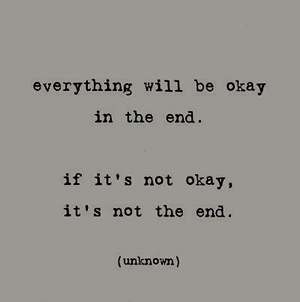
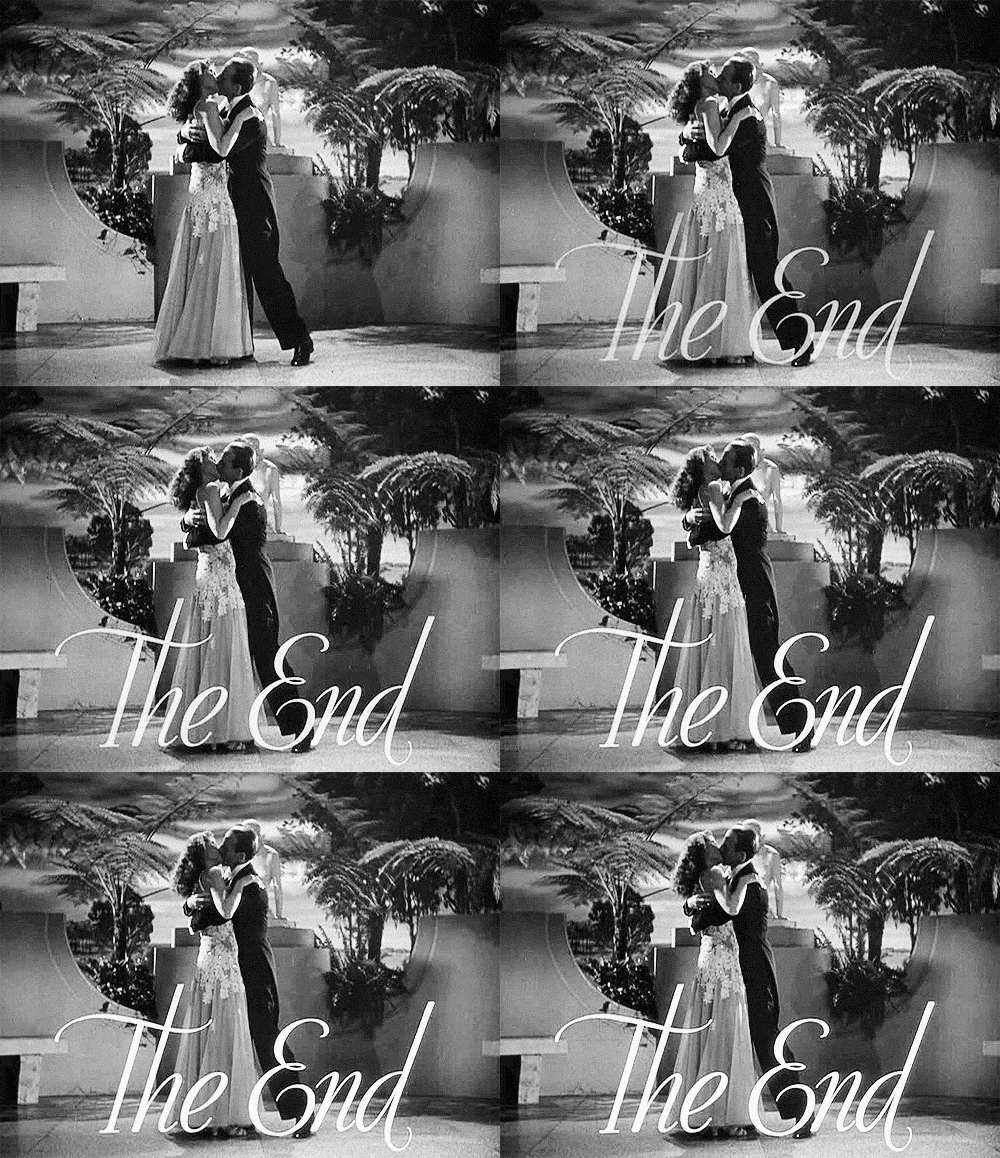
If the uses of in the end and at the end aren’t clear to you, keep reading – they’ll make perfect sense in the end, as it’s explained at the end of this introduction. Hehe…
At the endrefers to a specific time or location, while in the endis an idiomatic phrase that means “in conclusion” or “in summary.”
Consider these examples:
At the end of the day we went home. In the end, it was a long day.
At the end of the game, our team won. In the end, our team won.
We were happy in the end. We weren’t happy at the end of the movie.
The heroes won in the end. The heroes celebrated at the end of their journey.
In the end
In the end means “finally,” “after a long time,“ or, “when everything is considered.“ It is often followed by a comma. Here are some sentences with this idiom:
We worked hard, and in the end, we achieved our goal.
In the end, everything is going to be fine.
All will turn out well in the end.
In the end we decided not to buy it.
I waited for a bus for an hour and, in the end, I decided to take a cab.
At the end
At the end is most commonly used followed by of, to refer to the end of a specific noun. This noun can be a physical object (book), a period of time (day), an event (class, game, concert), a place (street, avenue), or something more abstract (life).
Here are some sentences with at the end + of:
I’ll meet you here at the end of the concert.
At the end of the class, the teacher said she wanted to talk to me.
We all went home at the end of the game.
There’s this gigantic house at the end of the street.
I will have an answer at the end of the day, ok?
At the end of his life, he had no regrets.
Put a period at the endof every sentence.
I pay the phone bill at the end of each month.
There is a brick building at the endof the road.
My boss asked me to stay one more hour at the end of my shift.
The bathroom is the last door on the left at the end of the corridor.
Note: sometimes we can also omit the of with at the end, for example at the end of a sentence, but even so it is possible to see that we are talking about the end of something.
Example:
• This book is amazing, but I can’t tell you what happens at the end.
Also, remember that one of the best ways to learn them is by watching how they are used, when reading a book or watching a movie or a series. Notice how they are used in context.
Southern hemisphere winter officially began on Monday, June 21, and runs until September 22, 2021.
Brrr! The Cold weather lesson shows some vocabulary to describe these sometimes sunny days, sometimes rainy, or days when the winter temperatures dip low.
And the only thing I can think of, to tell people is:
“Make sure you keep warm!”
To keep/stay warm means to keep your body warm, meaning wear the right clothes or do the correct activity or thing to keep yourself warm (referring to body temperature).
Stay warm implies that the person is already warm. So, like, if a delivery guy comes to your house and complains about the cold while you are having a friendly conversation, as he leaves, you might say, “Keep warm today!”
So, they are often used as a closing, in place of or immediately following “goodbye.”
Stay is a less active verb than keep. Keep indicates more intentionality. They’re interchangeable.
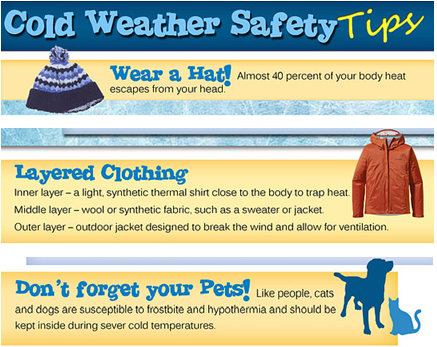
Next, a few tips to deal with cold weather. Listen to them and look up the words you don’t know. Notice pronunciation and how words are combined. Take notes.
For other closing expressions related to the pandemic, check out Stay safe.
Hmmm, I wasn’t quite right about this particular combination of words. I’ve seen a lot in these at least 30 years dealing with the English language, and that’s not enough when we think of the number of possibilities we have to communicate something. There are certainly the more usual ways in which some words are often used together, but sometimes other combinations are possible. That’s when doing a bit of research comes in handy.
So should we say: take or get the vaccine?
First, check it out the lesson Get or take? to situate yourself regarding the usage of these two verbs because how to use them, is a question shared by many English learners.
Could you grasp the difference in usage between get and take? If your answer is yes, we can now go back to our question above: take or get the vaccine?
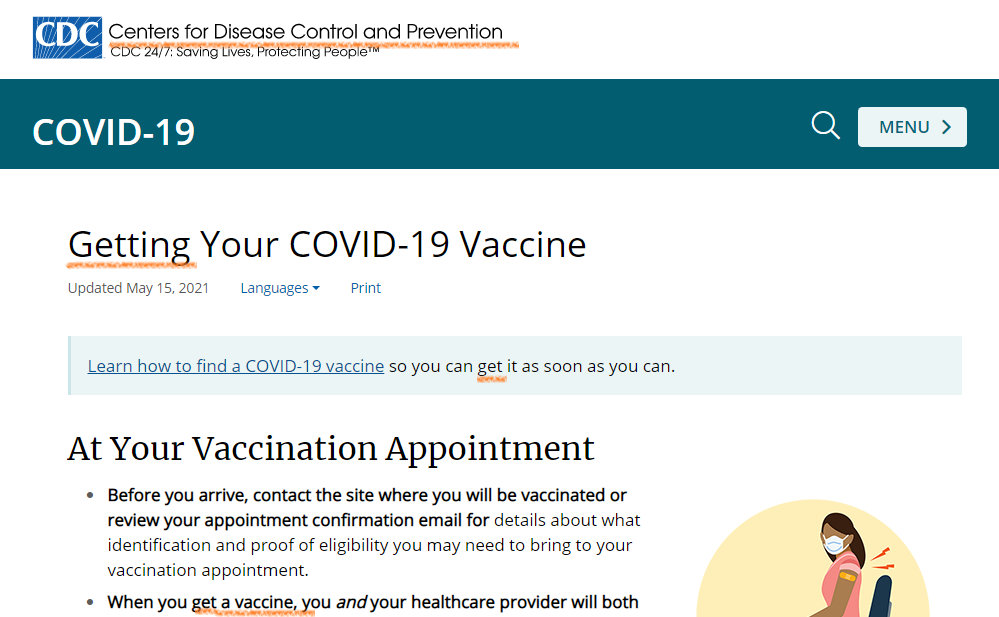
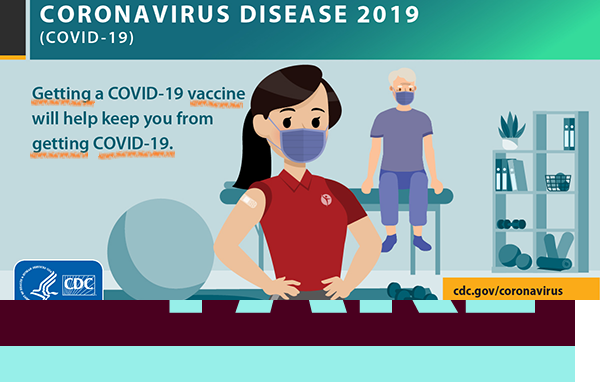
CDC – Centers for Disease Control and Prevention, the national public health agency of the United States, mostly combines the word vaccine with the verbs get and receive.
To understand the getting COVID-19 above, check the Verbo “to get” lesson.
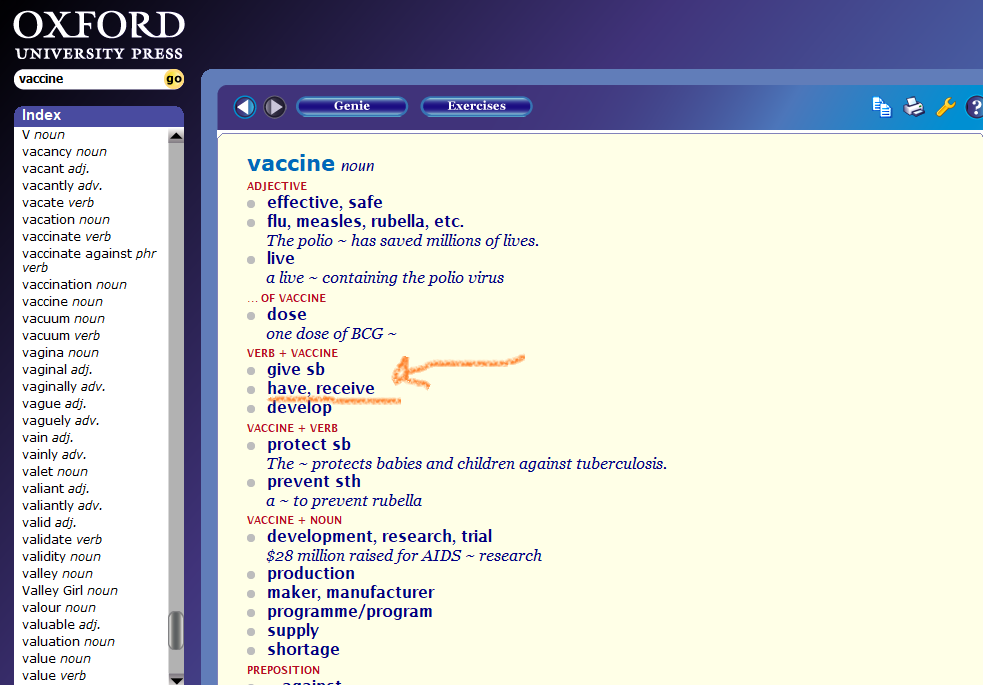
The Oxford Collocations Dictionary gives the verbs have and receive.
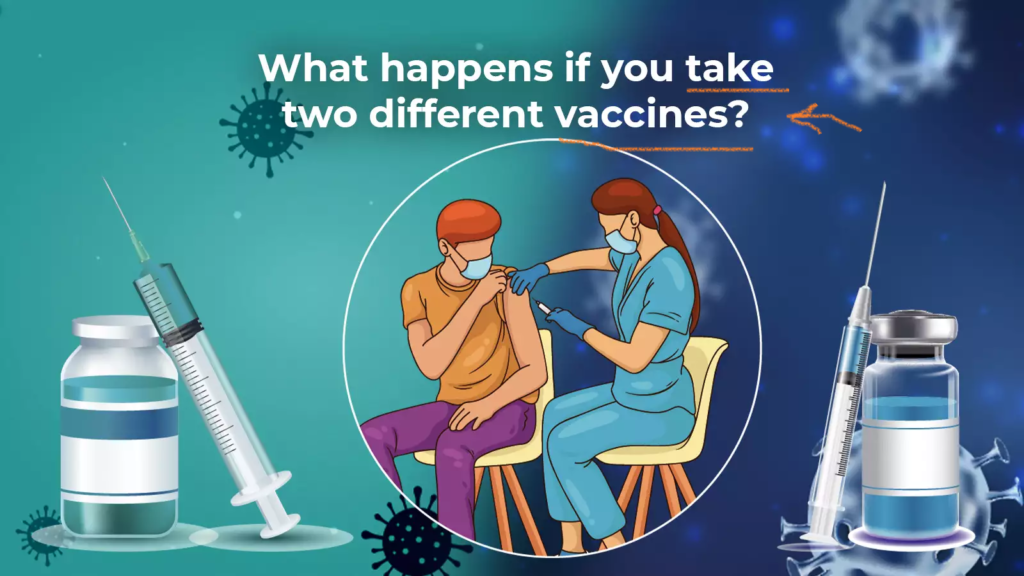
But yeah, to combine the word vaccine with the verb totake seems to be possible as this article from the World Economic Forum shows! And it makes sense if we think that we take medication.
So, although on the one hand the word vaccine is more commonly combined with the verb to get, on the other hand, we can assume that yes, it’s possible to say:
“My parents took the vaccine.”
So I want to thank my dear students for the insights you bring to class, things that might have never crossed my mind. This teaches me to be more careful and slow to jump to conclusions. I know it’s a lesson I’ll forget sometimes, but I’ll keep trying.
This is a question shared by many English learners.
The main difference between these two words concerns ‘who’ is performing the action.
Get is passive, and take is an active verb.
But I suggest you check the Verbo “to get” lesson first.
The following video shows a few main points to start with. Make sure to take notes! 😉
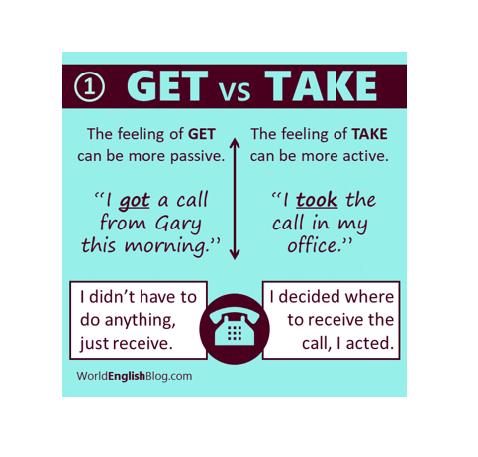
GET means to gain possession of something. Is a more casual (common) way of saying “obtain” or “receive”.
Get can be used when another person (or thing) gives you something. This is more passive.
I got a call from Gary this morning. (I received a call from Gary this morning. This is passive, I just received the call.)
Ellen got the new bike on her birthday.
TAKE means to move or carry something from one place to another.
Ellen takes her new bike everywhere she needs to go.
Take doesn’t always need another person (or thing). Something can be taken by a single person in the sentence.
I took the call in my office. (I accepted/received the call in my office. This is more active, I decided where to accept the call. I am also the only person in this sentence.)
Let’s look at another example:
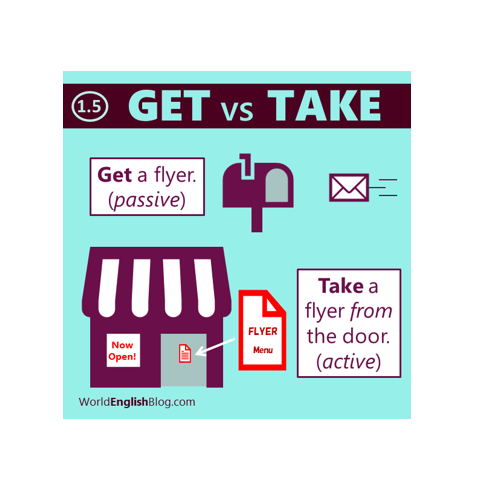
There is a new Italian restaurant near my office. I got a flyer this morning. The restaurant looks good.
– This sentence is passive, we don’t know how I received the flyer, maybe someone gave it to me, or maybe it came in the mail. We only know that I have it, I received it.
Compare:
There is a new Italian restaurant near my office. I took a flyer this morning from the front door. The restaurant looks good.
– This sentence has an active feeling, we know how I received the flyer and we know what I did to receive it. I took it from the front door. The flyers were offered and I accepted one.
Take can sometimes have a negative feeling
You can take something that is offered to you, like a flyer, some food, etc. This is to accept something. But… If you remove something that is not offered to you we still use the verb take, but the meaning is negative. This can mean stealing:
Someone took my bicycle from the park. (Someone stole my bike.)
Or it can be a mistake:
I left the house in a rush this morning and I took my wife’s keys by accident. (I grabbed my wife’s keys by mistake.)
Compare:
I got $20 from my Dad for helping him clean the garage. My Dad gave me the money. I took $20 from my Dad’s wallet. I stole $20 from my Dad. I removed $20 without permission.
Take can also suggest to gain possession of something by force, illegally or unfairly. Then it is similar to verbs like “seize” and “capture”.
The military took control of the country after the soldiers rebelled.
Take is also often used more idiomatically (cannot be understood from the meanings of its separate words but that has a separate meaning of its own) as well, in providing directions to a place. For example:
Jack’s store is on Robbins Road. Take 4th Street for a mile and you will see it.
In that case, take means “use” or “follow”.
Confusingly, take can also be used similar to the verb “give”, like in this sentence:
Michael takescare of Jennifer’s dog.
In that case, the speaker means Michael is the person responsible for meeting the dog’s needs. He is the caregiver to the dog.
Finally, take is often used in connection with expressions of time. For example:
Ellie takes 30 minutes to get ready for work.
That sentence has the exact same meaning as Ellie spends 30 minutes to get ready for work.
Get also is common to idiomatic expressions. It often substitutes for “understand” and “know” (check out the Verbo “to get” lesson). Look at this sentence:
I get that we have to learn math but I do not like it.
Sometimes that usage clearly suggests a speaker’s impatience or frustration:
“I get it, Mom! I have to clean my room today.”
Finally, get is a common substitute for “feel”, “become”, or “start”, among others (check the Adjectives for feelings lesson). Here are some examples:
I’m going to leave for lunch when I get hungry.
She gets sad on rainy days.
He left the show when the music got loud.
There are many more idiomatic uses of get and take. Look for them whenever you get to practice your English! Hehe…
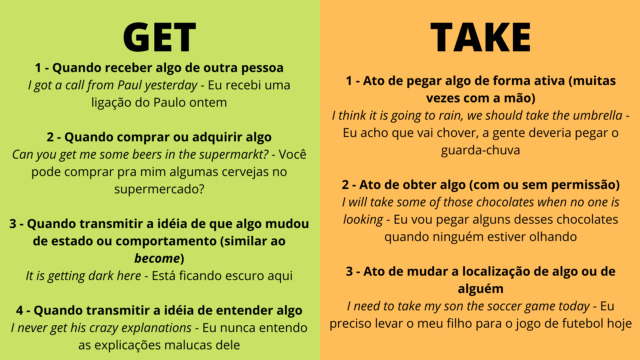
Below is a chart to help you with all this information.
What you have to understand is that both get and take are very common verbs in the English language and they are used with hundreds of different expressions.
The best thing that you can do is recognize when an expression uses get or take, understand how that expression is being used, practice the expression, get comfortable with it and add it to your speech.
It’s more effective to simply learn get or take in a natural context when you see them, when you’re listening to TV, when you’re watching a movie, when you’re reading a book and add it to your vocabulary after a lot of practice and repetition.
For some practice, work on a quiz about get and take.