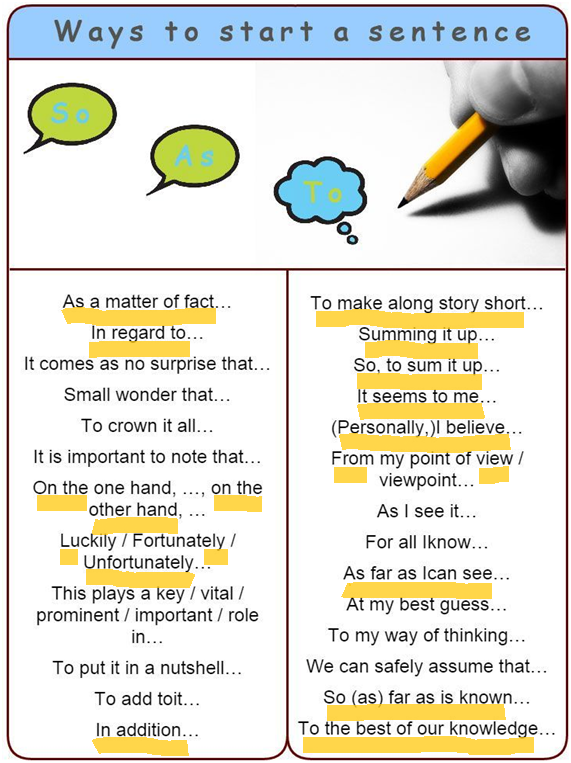
We’ve already learned ways to start stating, giving (sb), expressing our opinion. Now we’re going to look at other ways to support our opinion and conclude the discussion.

We’ve already learned ways to start stating, giving (sb), expressing our opinion. Now we’re going to look at other ways to support our opinion and conclude the discussion.


So what do you think? How do you state / express / give (sb) your opinion about something? You can start with:
If you agree, you can say:
If you disagree, then you can say:
If you partially agree, say:
And finally, if you strongly disagree, say:
Then, you can give reasons to support your opinion, and conclude, saying:
That will be all for today guys!
For more ways to support your opinion and conclude the discussion, click here.
These are two verbs that sometimes confuse students: lend and borrow. Watch the videos, make notes about what they say and practice.


It’s such a good feeling when you show a student a way of expressing his or her ideas, and the student comes back next time having perfectly mastered that new piece of language!
Temperatures are changing, and it was kind of cold today. The student came to class and I asked her: “Is it cold outside?” She answered: “Yes, but I wrapped up warm!” Oh! I’ve got so happy!!
So, thanks to all of you who fill my heart with hope and joy!
And keep up the good work! 😉
Hi everyone! I put together this post to answer a student’s question! Hehe… Do we say Gloria Hotel Accommodations?

There are three main ways in which we can put nouns together so that the first noun modifies or describes the second.
Mostly used to make ‘classifying’ expressions, which name a particular kind of thing. The first noun works a little like an adjective.
a horse race / a war film / milk chocolate
The noun + noun structure is also used in measurements, with a number before the first noun. The number is usually joined to the first noun by a hyphen (-). Note that the first noun is normally singular in form in these cases.
a three-day weekend / a ten-pound note / a two-hour lesson
Used to talk about several different sorts of ideas: possession, relationship, physical features and characteristics, non-physical qualities and measurements of a person or animal, or of a country, organization or other group of living creatures.
my sister’s car / a bird’s nest / cow’s milk
Used to talk about parts of non-living things and in other cases.
the top of the page / a feeling of disappointment
This is a very complicated area of English grammar. The ‘rules’ given above show the general patterns, but unfortunately there is no easy way to be quite sure which structure is used to express a particular compound idea. The most common expressions will be learnt by experience; in cases of doubt, a good dictionary will often show which form is correct.
By the way, hotel accommodation means the facilities and the quality of accommodation provided by a hotel:
This includes hotel accommodation, meals and bike hire. Times, Sunday Times (2008)
I hope you will find this information helpful! 😉
Practical English Usage – Michael Swan