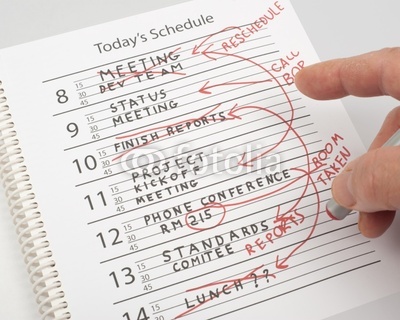
Are you “on schedule”?

I have already talked about the word schedule, but let’s refresh your memory and add a few more things.

Schedule – noun: ˈʃedjuːl, ˈske- $ ˈskedʒʊl, – dʒəl 

1 a plan of what someone is going to do and when they are going to do it:

production schedule 

hectic/tight (= very busy) schedule

How can he fit everything into this busy schedule?

2 a list of the times when events are planned to happen, for example, the times when classes happen or when buses, etc. leave and arrive (UK timetable):

The class schedule is available on the website.

bus schedule

schedule of talks at the convention

3 a formal list of something, for example prices

schedule of postal charges

schedule of business expenses

Now, things can happen:

on schedule

at the expected or planned time/at the right time, not early or late:

The bus arrived on schedule.

We are on schedule to meet our targets.

Her first baby arrived right on schedule.

according to schedule

at the time or in the way that was planned:

If everything goes according to schedule, work will be complete in December.

Everything went according to schedule.

ahead of schedule

early, before the planned time:

The meeting finished ahead of schedule.

If things continue to run ahead of schedule, construction could be finished two months early.

behind schedule

to do less work than you planned to do by a particular point in time:

We are already two months behind schedule.

The project started six months late and continued to fall behind schedule.

run behind schedule

1 to arrive and/or leave later than the time that is expected, after the planned time:

The trains are running behind schedule.

2  to do something or happen later than planned or expected or to take longer than planned or expected: 

The doctor’s appointments are running behind schedule today.

 The doctor is running behind schedule today.

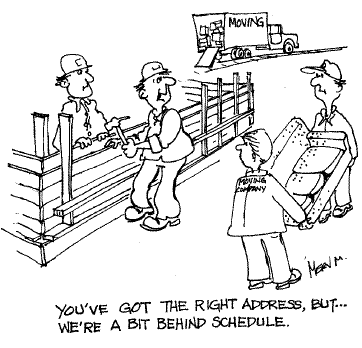
The project is running behind schedule.
https://dictionary.cambridge.org/dictionary/english/schedule

https://www.ldoceonline.com/dictionary/schedule

https://www.merriam-webster.com/dictionary/run%20behind%20schedule

“Já estou indo! I’m coming!”

Yesterday we learnt how to say: “Estou a caminho!/ I’m on my way!” Você diria isso, se está em um local diferente daquele em que está a pessoa a qual irá encontrar.

Mas digamos que você esteja em um canto qualquer da sua casa, ou mesmo em outro local fora, longe, e de repente alguém lhe chama, ou lhe telefona chamando. Em português, a resposta mais natural nesse momento é “já tô indo”, ou ainda, um simples “já vai”, se estiver perto. Duas formas bem comuns e informais de indicar à outra pessoa (a que lhe chamou) que você a ouviu e, portanto, está fazendo o que ela pede. Você poderia querer dizer “I’m going”, afinal, é assim que traduzimos (ao pé da letra) a expressão ‘estou indo’ para o inglês. Mas é um erro! O correto é dizer “I’m coming”.

I'm coming

Pode parecer estranho, parecer não ter lógica! Mas preste atenção ao ver filmes e seriados, bem como presenciar situações reais e perceba que todas as vezes em que alguém é chamado até o local onde outra pessoa está, a resposta é sempre “I’m coming” e não “I’m going” e muitas vezes, apenas “coming!” (de modo bem enfático).

Portanto, cuidado com as traduções literais!

Based on Denilso de Lima  https://www.inglesnapontadalingua.com.br/2011/04/como-e-que-se-diz-ja-to-indo-em-ingles.html

I’m on my way!

Como podemos dizer que ‘estou a caminho’ em inglês? Uma das maneiras mais comuns de dizermos que ‘estou indo’ para algum lugar ou ‘estou a caminho’ de algum lugar é I’m on my way to + place.

Por exemplo:

I’m on my way to work. – Estou indo para o trabalho.

I’m on my way to the gym. – Estou a caminho da academia.

I’m on my way to the mall. – Estou indo para o shopping.

Agora, cuidado. Veja como a expressão ‘on my way’ fica quando usamos ‘downtown’ e/ou ‘home’:

I’m on my way downtown. – Estou indo para o centro.

He’s on his way home. – Ele está a caminho de casa.

Podemos dizer também, sem mencionar onde vamos, que já estamos a caminho, veja:

A: Where are you? You are late for the meeting! – Cadê você? Você está atrasado ‘pra’ reunião!

B: I’m on my way! – Estou a caminho! ou, Estou indo! (‘Tô indo.’)

on-my-way-to1 (1)

Já quando nos referimos a outras pessoas, usamos a expressão da seguinte maneira:

A: Where is she going? – Aonde ela está indo?

B: She’s on her way to the supermarket. – Ela está indo ao supermercado.

A: Where is he going? – Aonde ele está indo?

B: He’s on his way to the park. – Ele está a caminho do parque.

A: Where are your parents going? – Aonde seus pais estão indo?

B: They are on their way to the airport. – Eles estão indo para o aeroporto.

On my way 2

Quando queremos dizer que ‘estou vindo ou voltando’ de algum lugar, usamos I’m on my way from + place. Veja os exemplos abaixo:

I’m on my way from work. – Estou vindo do trabalho.

I’m on my way from the gym. – Estou voltando da academia.

I’m on my way from the mall. – Estou vindo do shopping.

O mesmo acontece quando falamos sobre outras pessoas. Veja nos exemplos:

A: Where is she coming from? – De onde ela está vindo?

B: She’s on her way from the supermarket. Look at all those bags – Ela está vindo do supermercado. Veja quantas sacolas.

A: Where is he coming from? – De onde ele está vindo?

B: He’s on his way from the park. – Ele está vindo do parque.

A: Where are your parents coming from? – De onde seus pais estão vindo?

B: They are on their way from the airport. – Eles estão vindo do aeroporto.

How about you? Where are you going or coming from? Tell me!

https://blog.influx.com.br/2013/12/06/como-se-diz-estou-a-caminho-em-ingles/

Be a part of it!

A careful work on videos is a very useful tool to improve listening, to acquire vocabulary and to see how the parts of speech fit together. And best of all, to look at all these things at the same time, in context.

So here is a nice video, that teaches us essential vocabulary, in order for us to be able to participate in a discussion about the future of our country! Be a part of it! 😉

Is this seat taken?

Suppose you’re on a bus/train. How do you ask the other passengers if a seat is unoccupied?

OR

Is this seat free?

OR

Is this chair/seat empty?

Is this chair/seat vacant?

Now, with the word ‘house’ or ‘apartment’:

The house has been empty for some days now. There is nobody in the house but it does not mean that you can occupy or buy it; it may be that the residents are out of town.

The house has been vacant for some days now. There is nobody living in the house and so if you want to live in it by renting or buying it, you can do so.