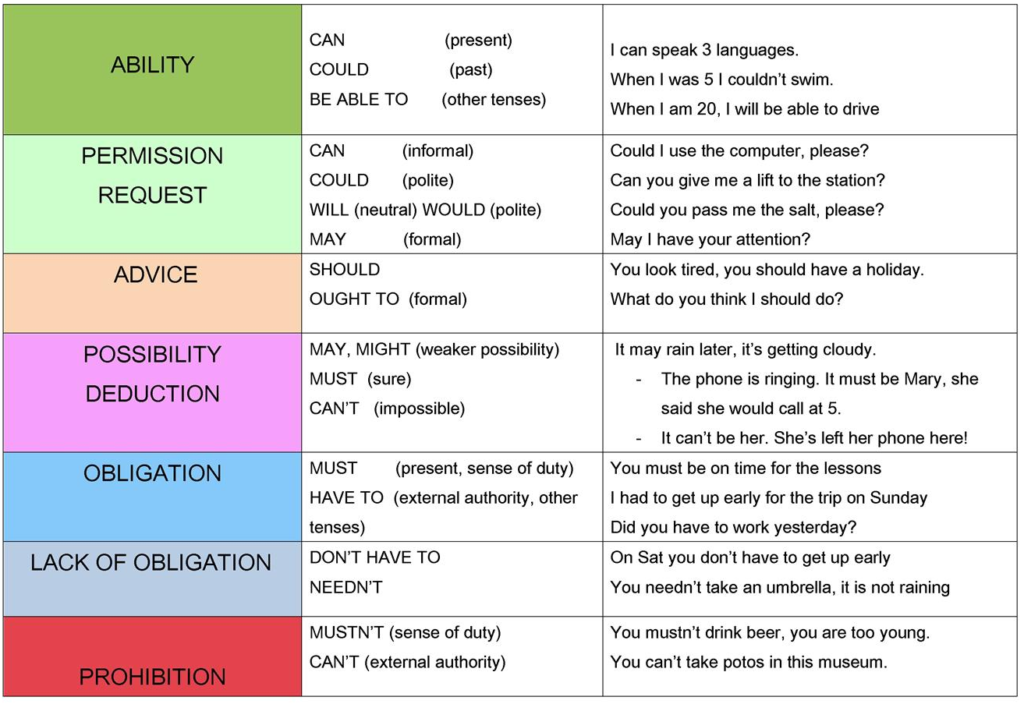
Modal verbs help other verbs to express if something is likely to happen, or certain to have happened; whether or not something is possible, or whether or not we have the ability to do something; whether or not we have the permission to do something; and whether or not we have the obligation or requirement or need to do something.
All the auxiliary verbs except be, do and have are called modals. But unlike other auxiliary verbs, modals only exist in their helping form; they cannot act alone as the main verb in a sentence.
Thus they do not change their form (spelling) and have no infinitive or participle (past/present).
Notice that be, do, and have can also serve as ordinary verbs in a given sentence.
The modal verbs are: can, could, will, would, shall, should, must, ought, may, might. Below is a list showing them according to the idea meant to be expressed:
Modals verbs are an extensive area of English grammar. Learners are usually introduced to them all at once, and they should certainly start checking each one, but most of all, they should notice the context, to feel which modal is necessary to express the idea. A lot of times, there will be more than one possibility. Don’t worry! This comes with time, exposure, practice and consistent correction. 😉
A couple of days ago, at the time of the novel Coronavirus outbreak in Brazil, we learned the vocabulary we need to talk about this disease that became a pandemic.
So, by now, I think I can safely assume that you know everything about the Coronavirus, and you know how important it is to…
And…
In the above sentences the form of the verbs are in the imperative. The imperative expresses an order.
For example, in the order ‘come here’, ‘come’ is in the imperative.
Now use these sentences to keep you and the people around you safe! 😉
Idade pode ser um assunto presente em rodas de conversa, principalmente entre pessoas que se conhecem, mas nem tanto assim. Então surge a pergunta:
How old are you? (Quantos anos você tem?) How old is Robert? (Quantos anos o Robert tem?)
Seguem algumas dicas básicas para falar sua idade com desenvoltura e graça em uma conversa em inglês.
To be
Em inglês, você não tem idade. Você é a sua idade. O verbo ser em inglês é o to be. Portanto, use-o para expressar quantos anos você tem. A própria frase How old are you? contém o verbo to be.
How old ARE you?
I’m 34 years old. (Eu tenho 34 anos de idade). He is 27. (Ele tem 27 anos.) She’s just 5 years old. (Ela só tem 5 anos de idade.)
Note que é possível subtrair o years old e dizer que a pessoa é apenas os anos que tem. Então:
She is 14. (Ela tem quatorze.)
Então cuidado: se você usar a palavra years com referência à idade, lembre-se de usar o old junto. Ou seja, não diga apenas: I’m 16 years. O certo é I’m 16 years old ou apenas I’m 16.
O to be sempre é o verbo para falar de idade. Há situações em que você precisa mudar o tempo verbal para expressar outra ideia, mas o verbo auxiliar continua o mesmo. Veja:
How old were you when you graduated? (Quantos você tinha quando se formou?) How old will you be when you retire? (Quantos anos você terá ao se aposentar?)
At
No Brasil, ao tentarmos dizer que fizemos alguma coisa, dizemos que fizemos COM determinada idade. Assim: Pulei de paraquedas com 18 anos.
Entretanto, regra básica: português e inglês são diferentes. Você provavelmente erra quando faz traduções diretas. E é o caso aqui. No inglês, você não usa with (com), mas at.
O correto, nesse caso, é:
I parachuted at 18. (Pulei de paraquedas aos 18 anos.) At 34, I will get my best physique. (Aos 34, terei a minha melhor forma física.) He is going to be an incredible professional at 28. (Ele será um incrível profissional aos 28 anos.)
Turn
No português, temos o famoso “fazer”. Fazer anos: Eu farei 28 anos no mês que vem.
Porém, em inglês, você não faz anos. Você vira. Você se transforma naquela idade. Ou então, de forma figurativa, seu calendário vira para a idade que está para chegar. Faz sentido? Talvez não para nós, mas para o falante de inglês…
Então, a frase acima será assim:
I’m turning 28 next month.
O melhor tempo verbal a empregar para o futuro, ao usar turn, é o futuro com o to be no presente + –ing.
He is turning 60 in 3 days. (Ele vai fazer 60 em 3 dias.)
Para falar de eventos que ocorrerão num futuro mais distante, é melhor usar o future continuous (will + be + -ing):
She will be turning 40 in 2025. (Ela irá fazer 40 anos em 2025.)
Usando idade como adjetivo ou substantivo
Em inglês, falar a idade pode se tornar um adjetivo ou um substantivo. Veja:
Adjetivo
This 7-year-old kid goes to school alone. (Esta criança de 7 anos vai para a escola sozinha.)
Note que o plural, em year, nesse caso de uso como adjetivo, desaparece. É 7-year-old. E também são usados os hifens. Isso é uma regra, não esqueça.
Substantivo
Já como substantivo, ocorre a flexão de número.
Some 3-year-olds are spoiled. (Algumas crianças de três anos de idade são mimadas.)