
Prepositions are words that show the relationship between people, objects, or places. They can describe location, movement, or direction.
Learning prepositions by function (place, movement, or direction) makes them much easier to understand and remember than memorizing them as one long list.
1. Position (Static Location)
These prepositions describe where something or someone is.
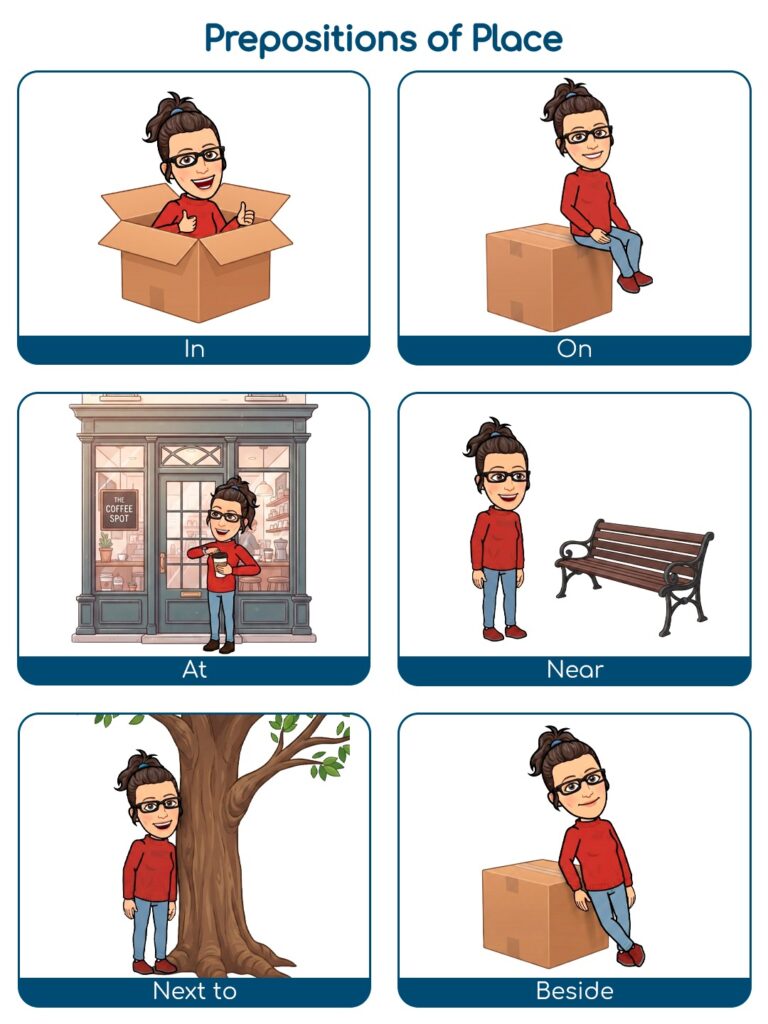
| Preposition | Meaning | Example |
|---|---|---|
| in | inside | The keys are in the bag. |
| on | touching a surface | The book is on the table. |
| at | a specific point | She’s at the bus stop. |
| near | close to | We live near the park. |
| next to | immediately beside | The bank is next to the supermarket. |
| beside | at the side of | She sat beside her friend. |
| in front of | before something or someone | The car is in front of the house. |
| behind | at the back of | The dog is behind the tree. |
| between | in the middle of two people or things | The pharmacy is between the bakery and the bank. |
| among | in the middle of three or more or things | He was standing among his friends. |
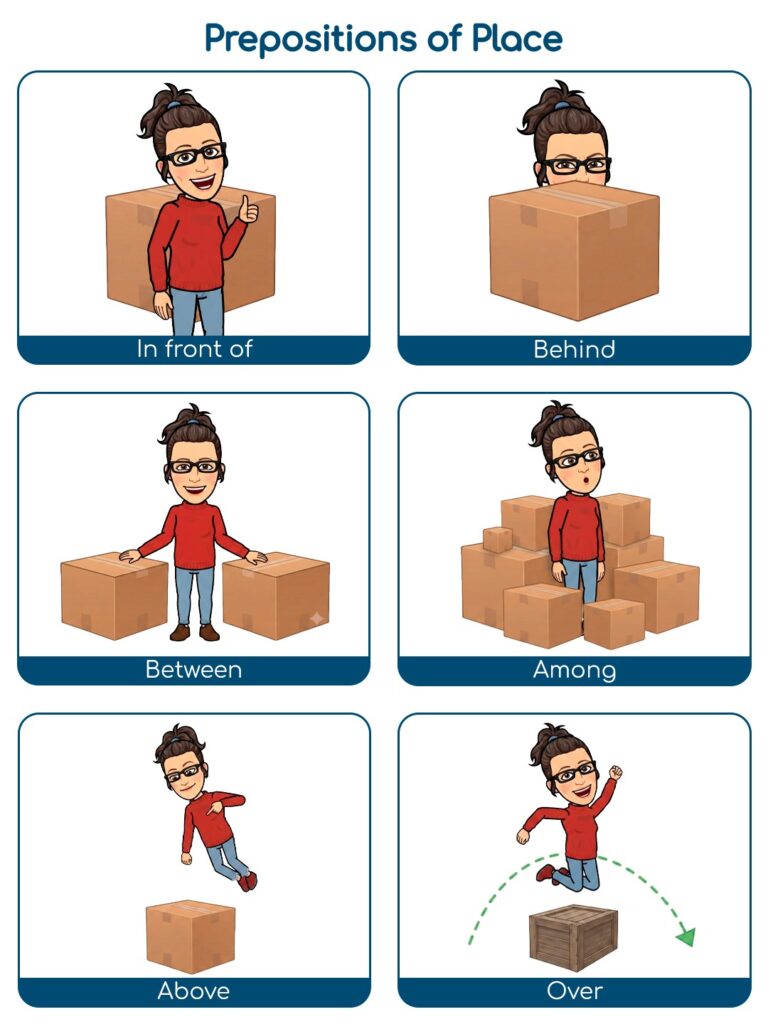
1a. Vertical Position
These prepositions describe the position of one object in relation to another vertically.
| Preposition | Meaning | Example |
|---|---|---|
| above | higher than (without touching) | The airplane is above the clouds. |
| over | above, often covering or directly higher than | A bridge goes over the river. |
| under | directly below | The cat is under the table. |
| below | lower than (not necessarily directly underneath) | The clouds are below the airplane. |
Remember
- Above = higher than
- Over = above, often with movement or covering
- Under = directly underneath
- Below = lower than
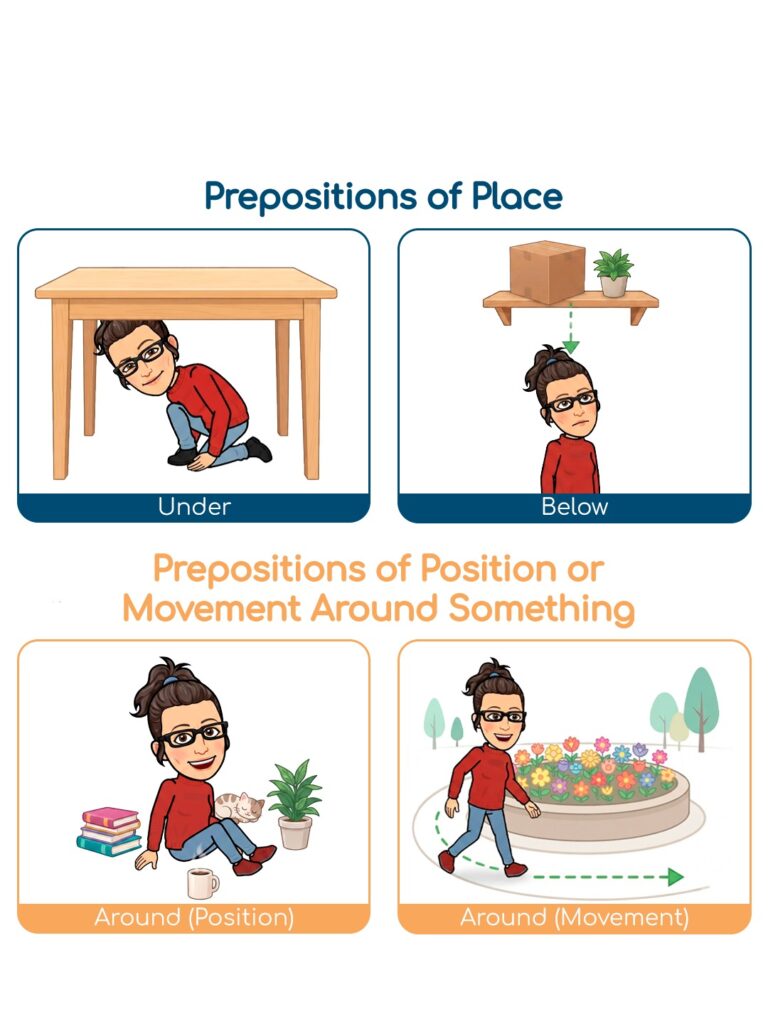
2. Position or Movement Around Something
| Preposition | Meaning | Example |
|---|---|---|
| around | surrounding or moving in a circle | We walked around the lake. |
Around can describe both a position (“There are trees around the house.”) and movement (“We walked around the lake.”).
3. Movement (Direction)
These prepositions describe movement from one place to another.
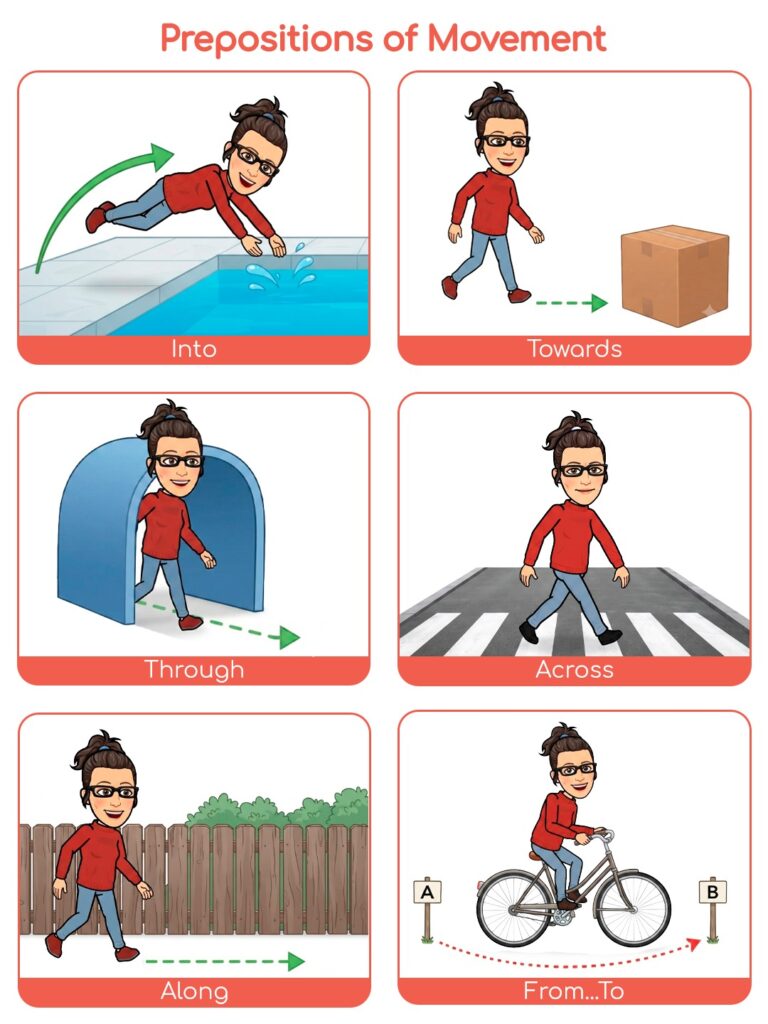
| Preposition | Meaning | Example |
|---|---|---|
| into | movement to the inside | She jumped into the pool. |
| towards | in the direction of | He ran towards the beach. |
| through | entering and exiting | We walked through the tunnel. |
| across | from one side to the other | They swam across the river. |
| along | following a line or path | We walked along the beach. |
| from…to | starting point and destination | She drove from São Paulo to Curitiba. |
Quick Comparison
At × In × On
These are the three most common prepositions of place.
- at = a specific point
- I’m at school.
- in = inside an enclosed space
- I’m in the classroom.
- on = on a surface
- My notebook is on the desk.
In × Into
- in = location
- into = movement
- The cat is in the box.
- The cat jumped into the box.
Above × Over
- above = simply higher than
- over = higher than, often covering or crossing
- The lamp is above the table.
- The airplane flew over the city.
Under × Below
- under = directly underneath
- below = lower than
- The shoes are under the bed.
- The sun disappeared below the horizon.
Near × Next to × Beside
- near = close to, but not necessarily immediately beside
- next to = immediately beside
- beside = at the side of (similar to next to, but slightly more formal)
- My school is near the park.
- The pharmacy is next to the bank.
- She sat beside her friend.
Between × Among
- between = two people or things
- among = three or more people or things
- She sat between Tom and Sarah.
- She sat among her classmates.
Across × Through
- across = from one side to the other
- through = inside an enclosed space
- We walked across the street.
- We walked through the tunnel.
Exercise 1 – Choose the Correct Preposition
- The cat is ______ the bed.
a) under
b) over - The picture is ______ the sofa.
a) above
b) below - We walked ______ the tunnel.
a) through
b) across - The children ran ______ the park.
a) around
b) into - She lives ______ the supermarket.
a) near
b) into - The bank is ______ the bakery and the pharmacy.
a) among
b) between - The airplane flew ______ the mountains.
a) over
b) under - He walked ______ the room.
a) into
b) in - They walked ______ the river on the bridge.
a) across
b) along
Exercise 2 – Complete the Sentences
Use in • on • at • behind • beside • near • around • through • across • under. More than one answer is possible.
- My backpack is ______ the chair.
- The children are playing ______ the garden.
- We met _____________________ the train station.
- The dog is sleeping _________ the table.
- She sat _____________________ her sister.
- We walked ________________ the forest.
- They live _________ the beach.
- The bookstore is ____________ the coffee shop.
- We rode our bikes ____________ the park.
- He swam ____________ the river.
Exercise 3 – Correct the Mistakes
- The cat jumped in the box.
- My house is next my school.
- She is standing among Tom and Sarah.
- The plane flew above the river.
- We walked across the tunnel.
- The supermarket is in front the bank.
- The dog is behind of the car.
- I arrived in the airport at 8 a.m.
- The lamp is over the ceiling.
- He ran in the bus stop.
Rewrite each sentence correctly.
Exercise 4 – Choose the Best Preposition
- The museum is ________ the library.
(near / through) - The children are walking ________ the street.
(across / among) - The cat is sleeping ________ the chair.
(under is not an option; use on or beside)
(on / beside) - She walked ________ the room quietly.
(into / in) - The trees are ________ the lake.
(around / between) - The hospital is ________ the school.
(next to / towards) - The train goes ________ the mountain.
(through / above) - The painting hangs ________ the fireplace.
(above / across)
Exercise 5 – Describe the Location
Answer using a complete sentence.
Example:
Where is the TV?
➡️ The TV is on the table.
- Where is your phone right now?
- Where is your English folder?
- Is there a supermarket near your house?
- What is across from your house/building?
- What is behind your house/building?
- What places are next to your home?
Exercise 6 – Translate into English
- O gato está debaixo da cadeira.
- O supermercado fica perto da escola.
- Ela entrou na sala.
- Caminhamos pela floresta.
- O avião voou sobre as montanhas.
- A farmácia fica entre o banco e a padaria.
- As crianças correram ao redor do parque.
- Nós fomos de Curitiba para Florianópolis.
- O livro está na mesa.
- A bola está dentro da caixa.
Answer Key
Exercise 1
- under
- above
- through
- around
- near
- between
- over
- into
- across
Exercise 2
- behind
- in
- at
- under
- beside
- through
- near
- beside (or next to)
- around
- across
Exercise 3
- The cat jumped into the box. (movement → into)
- My house is next to my school. (expression: next to)
- She is standing between Tom and Sarah. (between = two people)
- The plane flew over the river. (over is preferred when something moves above another object)
- We walked through the tunnel. (through = entering and exiting a space)
- The supermarket is in front of the bank. (expression: in front of)
- The dog is behind the car. (never use “behind of”)
- I arrived at the airport at 8 a.m. (arrive at + airports, stations, buildings; arrive in + cities/countries)
- The lamp is on the ceiling. (lamps are attached to the ceiling, so we use on)
- He ran to the bus stop. (movement toward a destination → to)
Exercise 4
- near – The museum is near the library.
- across – The children are walking across the street.
- beside – The cat is sleeping beside the chair.
(If the cat were on top of the chair, we would use on.) - into – She walked into the room quietly.
(Movement into an enclosed space.) - around – The trees are around the lake.
(Surrounding the lake.) - next to – The hospital is next to the school.
- through – The train goes through the mountain.
(For example, through a tunnel.) - above – The painting hangs above the fireplace.
(Higher than the fireplace.)
Exercise 5
- Where is your phone right now?
Sample answer: My phone is on my desk. - Where is your English folder?
Sample answer: My English folder is in my backpack. - Is there a supermarket near your house?
Sample answer: Yes, there is a supermarket near my house.
or No, there isn’t a supermarket near my house. - What is across from your house/building?
Sample answer: There is a park across from my house/buiding. - What is behind your house/building?
Sample answer: There is a garden behind my house. - What places are next to your home?
Sample answer: There is a bakery and a pharmacy next to my home.
Exercise 6
- O gato está debaixo da cadeira.
→ The cat is under the chair. - O supermercado fica perto da escola.
→ The supermarket is near the school. - Ela entrou na sala.
→ She went into the room.(or She walked into the room.) - Caminhamos pela floresta.
→ We walked through the forest. - O avião voou sobre as montanhas.
→ The airplane flew over the mountains. - A farmácia fica entre o banco e a padaria.
→ The pharmacy is between the bank and the bakery. - As crianças correram ao redor do parque.
→ The children ran around the park. - Nós fomos de Curitiba para Florianópolis.
→ We went from Curitiba to Florianópolis. - O livro está na mesa.
→ The book is on the table. - A bola está dentro da caixa.
→ The ball is in the box.