SIMPLE PAST – complete lesson

1. Verb Tenses Overview

Verbs come in three main tenses:

  • Present → things in general, routines, facts
  • Past → finished actions in the past
  • Future → things that have not happened yet

✔ Present Simple

Used for:

  • routines
  • general truths

Examples:

  • I live in Brazil.
  • She works every day.

👉 Note:

  • I / you / we / they → live
  • he / she / it → lives

✔ Future

Used for:

  • plans or actions in the future

Examples:

  • I will travel tomorrow.
  • She will call you later.

Watch the video carefully and take notes.

✔ Past Simple

Used for:

  • actions that are finished
  • actions at a specific time in the past

Common time expressions:

  • yesterday
  • last week / month / year
  • ago (two days ago, three years ago)
  • earlier

Example:

  • I visited my friend yesterday.

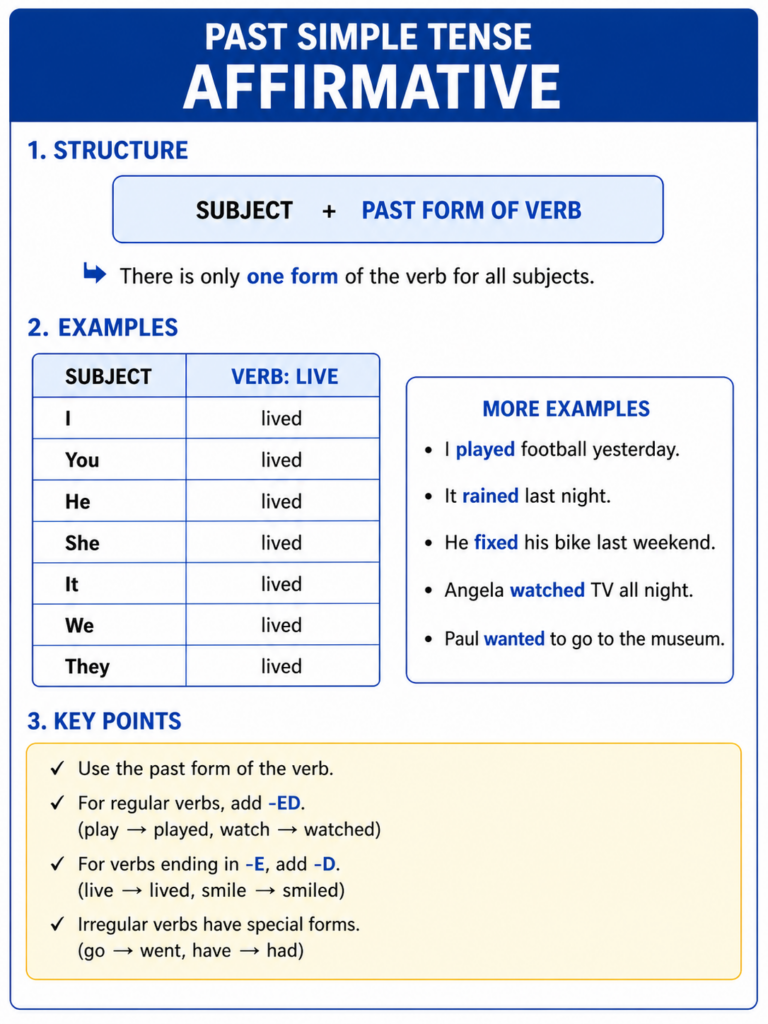
2. Structure of the Past Simple

👉 The good news:

✔ There is only ONE form of the verb for all subjects.

Example with LIVE:

  • I lived
  • You lived
  • He lived
  • She lived
  • It lived
  • We lived
  • They lived

⚠ Exception: the verb to be

  • was / were

3. Regular Verbs (Affirmative)

✔ Rule: Add -ED to the verb

Examples:

  • play → played
  • rain → rained
  • cook → cooked
  • watch → watched
  • want → wanted

✔ Verbs ending in -E: Add -D

  • live → lived
  • smile → smiled
  • dance → danced

✔ Examples in sentences:

  • I played my guitar yesterday.
  • It rained last night.
  • He fixed his bike last weekend.
  • Angela watched TV all night.
  • Paul wanted to go to the museum.

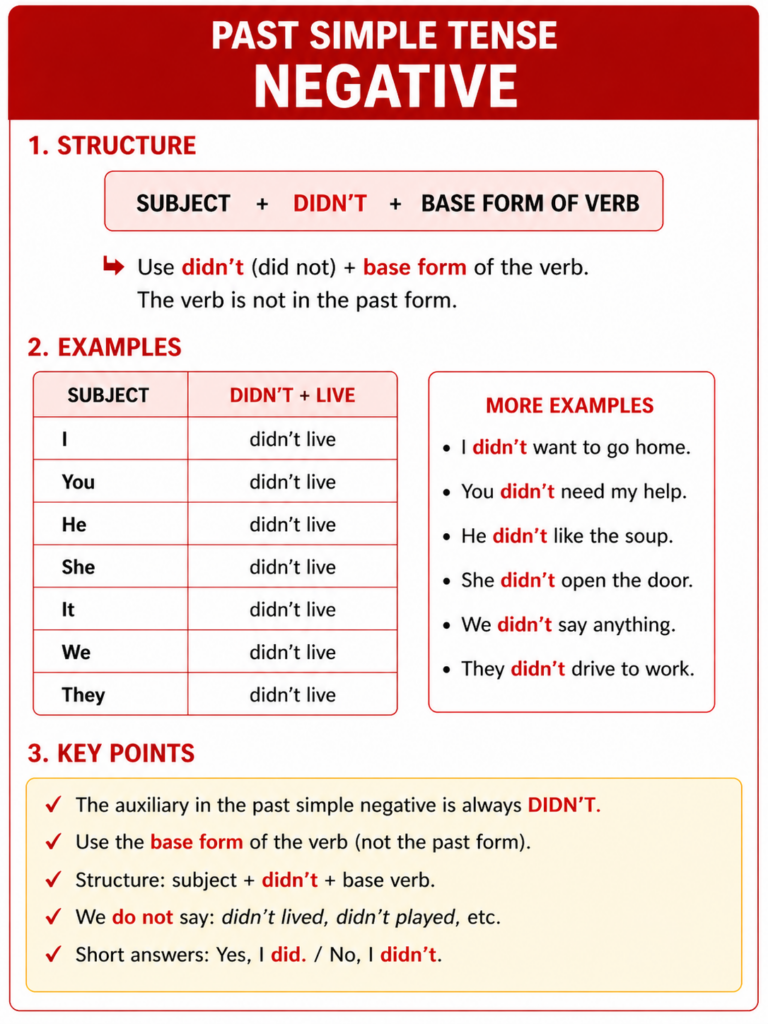
4. Negative Sentences

✔ Rule: Use did not (didn’t) + base verb

Structure: Subject + didn’t + base verb

Examples:

  • They lived in Spain → They didn’t live in Spain
  • I didn’t want to go home
  • She didn’t open the door

⚠ IMPORTANT:
❌ NOT: didn’t lived
✔ ALWAYS: base form


✔ Auxiliary in the Past: Only DID / DIDN’T

  • I didn’t
  • You didn’t
  • He didn’t
  • She didn’t
  • It didn’t
  • We didn’t
  • They didn’t

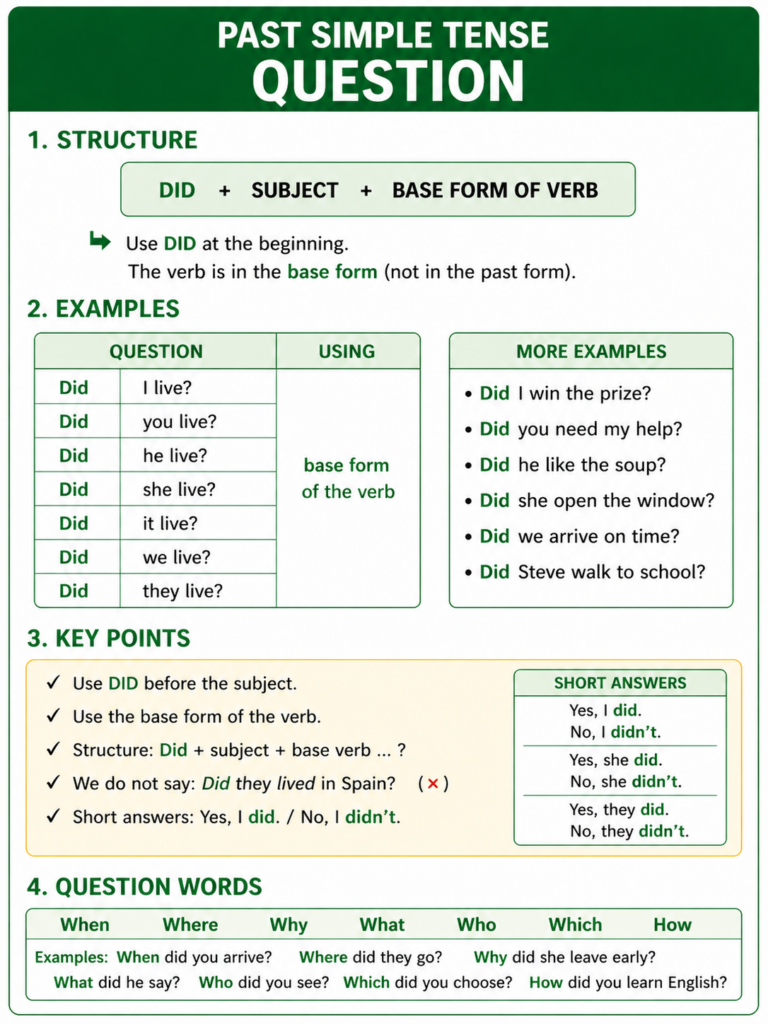
5. Questions in the Past Simple

✔ Rule: Use DID + subject + base verb

Examples:

  • Did they live in Spain?
  • Did you need my help?
  • Did she open the window?

⚠ IMPORTANT:
❌ NOT: Did they lived?
✔ ALWAYS: base form


6. Short Answers

  • Did you call her?
    ✔ Yes, I did. / No, I didn’t.
  • Did she finish?
    ✔ Yes, she did. / No, she didn’t.

7. Question Words

Use before DID:

  • When did you arrive?
  • Where did they go?
  • Why did she leave early?
  • What did he say?
  • Who did you see?
  • How did you learn English?

8. Irregular Verbs

Some verbs do not follow the -ED rule.

Example with GO:

  • Present → go / goes
  • Past → went

✔ Affirmative:

  • I went to the beach.
  • She went to the dentist.
  • They went to the library.

✔ Negative:

  • You went → You didn’t go

✔ Questions:

  • Did you go to the concert?

9. Key Insight

👉 Irregular verbs are only irregular in affirmative sentences

✔ Example:

  • You went
  • You didn’t go
  • Did you go?

📝 EXERCISES

A. Complete with the Past Simple

  1. I ________________ (play) tennis yesterday.
  2. She ________________ (watch) a movie last night.
  3. They ________________ (live) in Spain in 2010.
  4. He ________________ (cook) dinner yesterday.
  5. We ________________ (study) English last week.

B. Make Negative Sentences

  1. I visited my friend.
    → I _____________________________________
  2. She liked the movie.
    → She __________________________________
  3. They worked yesterday.
    → They _________________________________

C. Make Questions

  1. You finished the homework.
    → ______________________________________________?
  2. She opened the door.
    → ______________________________________________?
  3. They traveled last year.
    → ______________________________________________?

D. Choose the Correct Option

  1. Did you ___ to the party?
    a) went
    b) go
  2. She didn’t ___ the answer.
    a) knew
    b) know
  3. They ___ a great time yesterday.
    a) had
    b) have

E. Irregular Verbs Practice

Complete:

  1. I ________________ (go) to the beach.
  2. She ________________ (have) lunch at noon.
  3. They ________________ (see) a movie.
  4. He ________________ (make) a cake.

F. Personal Practice

  1. What did you do yesterday?
    → ____________________________________________
  2. Where did you go last weekend?
    → ____________________________________________
  3. Did you study English yesterday?
    → ____________________________________________

Holiday Time, Long Weekend & Holiday Mood


1️⃣ Warm-up (Conversation)

  • Do you like holidays?
  • How do you feel before a holiday?
  • What are your plans for Carnival?


2️⃣ Vocabulary

📅 Holiday × Vacation (US × UK)

  • Holiday
    • US English → feriado / período curto de folga
    • British English → férias / feriado / viagens de férias
  • Vacation
    • US English → férias (período mais longo)
    • British English → menos comum

📌 Exemplos:

  • Next week is a holiday.
  • Carnival is a holiday in Brazil.
  • We take our vacation once a year.


🗓️ Long weekend

Long weekend = feriado prolongado (3 ou 4 dias)

  • Carnival is a long weekend in Brazil.
  • We have a long weekend next week.
  • I’m traveling on the long weekend.

Common use:

  • on the long weekend
  • during the long weekend

💰 / ⏰ Spend

Spend = passar (tempo) / gastar (dinheiro)

  • I spend time with my family.
  • I want to spend the holiday at home.
  • I don’t want to spend a lot of money.

Structure:

  • spend + the holiday / the long weekend
  • spend + time / money

😌 Holiday mood

Holiday mood = para falar de estado emocional, clima ou atmosfera

👉 in a holiday mood

  • I’m already in a holiday mood.
  • Everyone is in a holiday mood.

on a holiday mood
at a holiday mood

✔️ IN a holiday mood

More examples with IN

  • in a good mood
  • in a bad mood
  • in a relaxed mood
  • in the mood to travel

📅 Workday

  • Workday = dia de trabalho

📌 Exemplos:

  • Monday is a workday.
  • Holidays are not workdays.

3️⃣ Model Sentences

  • Next week is Carnival holiday.
  • I’m already in a holiday mood.
  • I want to spend the long weekend resting.
  • Some people travel on holidays.
  • I prefer to stay home during Carnival.


4️⃣ Grammar Focus (Going to)

We use going to for plans and intentions:

  • I’m going to spend the holiday with my family.

5️⃣ Practice

📝 Exercise 1 – Complete with IN, HOLIDAY, VACATION or LONG WEEKEND:

  1. I’m ___ a holiday mood.
  2. We have a ___ because Carnival is on Monday.
  3. In the US, people say ___ instead of holiday.
  4. I’m going to spend the ___ at home.
  5. Everyone is ___ a relaxed mood this week.

📝 Exercise 2 – Complete the sentences

  1. Next week is a __________.
  2. Carnival is a __________ weekend.
  3. I want to __________ the holiday at home.
  4. I’m already in a holiday __________.
  5. I’m on __________ in July for two weeks.

🗣️ Exercise 3 – Personal answers

Answer with complete sentences:

  1. How do you usually spend holidays?
  2. Are you in a holiday mood now?
  3. What are your plans for the long weekend?

🗝️ Answer Key

Exercise 1

  1. in
  2. long weekend
  3. vacation
  4. holiday / long weekend
  5. in

Exercise 2

  1. holiday
  2. long
  3. spend
  4. mood
  5. vacation (US) / holiday (UK)

Holidays are not about doing more — they’re about feeling better.

Tell, Say, Speak & Talk (Beginner)

Quatro verbos que significam “falar” — mas os usamos de forma diferente

Estes verbos parecem semelhantes, mas cada um tem um uso. Vamos aprendê-los passo a passo.


1️⃣ TELL

Significado: dizer / contar algo para alguém

Regra simples

👉 Tell + person + something
❌ No to

Exemplos

  • I told you the truth.
  • I told Marcos the news.
  • I tell my son to eat well.

❌ I told to Marcos.

🧠 Remember: Tell já significa “a alguém”.


2️⃣ SAY

Significado: dizer palavras (foco no que é dito)

Regra simples

👉 Say + words

Normalmente NÃO mencionamos a pessoa. Quando usamos a pessoa, usamos to.
👉 Say + words + to + person

Exemplos

  • I said hello.
  • I said sorry to my mom.
  • I said, “Relax,” to my mom.

❌ I said Marcos.

🧠 Use say para palavras ou mensagens curtas.


3️⃣ TALK

Significado: conversar / falar (interação)

Regra simples

👉 Talk + to / with + person

Exemplos

  • I talked to my friend.
  • Talk to me.
  • We talked yesterday.

❌ Talk my friend.


4️⃣ SPEAK

Significado: falar (idiomas / de forma mais formal)

Simple rule

👉 Speak + a language
👉 Speak + to + person

Exemplos

  • I speak English.
  • She spoke to the teacher.

🧠 Comparação

VerboUse-o quando você quer…
Telldizer algo a alguém
Saydizer palavras
Talkter uma conversa
Speakfalar formalmente / idioma

✏️ Exercícios

Exercício 1 — Escolha o verbo correto

  1. I want to ______ you something.
  2. She ______ to her dad.
  3. Can you ______ English?
  4. Talk ______ me, please.
  5. He _____ her to eat.

Exercício 2 — Right or wrong?

Write ✔ or ❌.

  1. I told to my mom. ( )
  2. I said hello to my mom. ( )
  3. I talked my friend. ( )
  4. I speak English. ( )

Exercício 3 — Corrija

  1. I said Marcos hello.
  2. Talk me now.
  3. I told to her the truth.
  4. She told to the manager.

✅ Resposta

Exercício 1

  1. tell
  2. spoke
  3. speak
  4. to
  5. told

Exercício 2

Exercício 3

  1. I said hello to Marcos.
  2. Talk to me now.
  3. I told her the truth.
  4. She spoke to the manager.

Dica fácil:

  • Tell + person
  • Say + words
  • Talk to + person
  • Speak + language

Prepositions of Time: IN → ON → AT

In English, time goes like this:

IN (general) → ON (more specific) → AT (very specific)


👉 Think:

  • IN = big time
  • ON = one day
  • AT = exact moment

IN → general time 🗓️

We use IN for longer time.

Examples:

  • My birthday is in January.
  • She was born in 1995.
  • It is hot in summer.
  • I will call you in 10 minutes.

ON → more specific time 📅

We use ON for days and dates.

Examples:

  • I work on Monday.
  • My birthday is on July 10th.
  • We get paid on the 20th.

AT → very specific time ⏰

We use AT for exact time.

Examples:

  • I wake up at 6 a.m.
  • The class starts at 10 o’clock.
  • I left the party at midnight.

No preposition ❌

We do not use IN / ON / AT with:

today – tomorrow – yesterday – tonight
last – next – this – every

Examples:

  • I have class today.
  • The party is next Friday.

Practice 1 ✏️

Choose: IN, ON, AT

  1. My birthday is ___ May.
  2. I work ___ Monday.
  3. The class starts ___ 8 a.m.
  4. She was born ___ 2003.
  5. We have a test ___ Friday.

Practice 2 ✏️

Choose: IN, ON, AT, or Ø (no preposition)

  1. I’m busy ___ today.
  2. We travel ___ December.
  3. The movie starts ___ 9:30.
  4. I stayed home ___ last weekend.
  5. Let’s talk ___ the moment.

Practice 3 ✏️ (Speaking / Writing)

Complete with your information:

  • I was born ___ ________.
  • My English class is ___ ________.
  • I wake up ___ ________.

✅ Answer Key

Practice 1

  1. My birthday is in May.
  2. I work on Monday.
  3. The class starts at 8 a.m.
  4. She was born in 2003.
  5. We have a test on Friday.

Practice 2

  1. I’m busy Ø today.
  2. We travel in December.
  3. The movie starts at 9:30.
  4. I stayed home Ø last weekend.
  5. Let’s talk at the moment.

Tell, Say, Speak & Talk

Understanding Similar Verbs in English

These four verbs often confuse learners because they are all related to communication. However, they are not interchangeable. This lesson will help you understand the differences clearly and use each verb with confidence.


1️⃣ TELL

Meaning: to give information to someone

Structure

Tell + person + (what was said)
⚠️ NO “to” before the person

Examples

  • I told Marcos the truth.
  • She told me about the trip.
  • He told her to check it out.

❌ I told to Marcos.

👉 Tell already includes the idea of “to someone”.


2️⃣ SAY

Meaning: to express words / focus on the message

Structure

  • Say + something
  • Say + something + TO + someone

Examples

  • She said hello.
  • He said hello to Marcos.
  • I said I was tired.

❌ I said Marcos.

👉 If you mention the person, you need to.


3️⃣ TALK

Meaning: to have a conversation (interaction)

Structure

Talk + TO + someone

Examples

  • I talked to Marcos yesterday.
  • We talked about work.

❌ I talked Marcos.

👉 Talk focuses on interaction, not the message itself.


4️⃣ SPEAK

Meaning: to talk in a more formal way

Commonly used for:

  • Languages
  • Formal situations

Structure

  • Speak + a language
  • Speak + TO + someone

Examples

  • I speak English.
  • She spoke to the manager.

Quick Comparison

VerbStructure
Telltell someone (NO to)
Saysay something (to someone)
Talktalk to someone
Speakspeak to someone / a language

Exercises

Exercise 1 — Choose the correct verb

Complete the sentences with tell, say, talk, or speak.

  1. I need to ______ you something important.
  2. She didn’t ______ anything to me.
  3. We talked and ______ about our plans.
  4. He ______ to his boss this morning.
  5. Can you ______ English?

Exercise 2 — Correct the sentences

Find and correct the mistake.

  1. I told to her the truth.
  2. He said me the answer.
  3. She talked her yesterday.
  4. I speak to English at work.

Exercise 3 — Make the sentences correct

  1. I told ______ to check it out.
  2. She said it ______ Marcos.
  3. They talked ______ their trip.
  4. He speaks ______ Spanish and French.

🗝️ Answer Key

Exercise 1

  1. tell
  2. say
  3. talked
  4. spoke
  5. speak

Exercise 2

  1. I told her the truth.
  2. He told me the answer / He said the answer to me.
  3. She talked to her yesterday.
  4. I speak English at work.

Exercise 3

  1. you / him / her / them
  2. to
  3. about
  4. (no preposition)

More Practice

Exercise 4 — Choose the best option

Choose the correct verb.

  1. She didn’t ______ a word during the meeting.
  2. I need to ______ to you about something important.
  3. He ______ me he would be late.
  4. Can you ______ a little louder, please?
  5. They were ______ about their vacation.

Exercise 5 — Tell or Say?

Choose tell or say and make the sentence correct.

  1. She ______ me the truth.
  2. He ______ it to his parents.
  3. Don’t ______ anyone about this.
  4. What did she ______?

Exercise 6 — Rewrite using the verb in brackets

Rewrite the sentence using the verb in parentheses.

  1. I said to her, “Don’t worry.” (tell)
  2. He spoke to the teacher yesterday. (talk)
  3. She said hello to me. (tell)
  4. They talked to the manager. (speak)

Exercise 7 — Real-life use

Complete the sentences so they sound natural.

  1. I need to ______ my kids to slow down.
  2. She didn’t ______ goodbye.
  3. We need to ______ to the doctor.
  4. He ______ three languages.

🗝️ Answer Key

Exercise 4

  1. say
  2. talk
  3. told
  4. speak
  5. talking

Exercise 5

  1. told
  2. said
  3. tell
  4. say

Exercise 6

  1. I told her not to worry.
  2. He talked to the teacher yesterday.
  3. She told me hello.
  4. They spoke to the manager.

Exercise 7

  1. tell
  2. say
  3. talk / speak
  4. speaks

Teacher’s Note — SAY vs TELL (Important)

Although the structure say + something + to someone is correct, the type of something matters.

SAY sounds natural with:

  • short words or expressions (hello, sorry, goodbye)
  • direct speech (words in quotes)

Examples:

  • I said hello to my mom.
  • I said, “Relax,” to my mom.

⚠️ With long ideas or instructions, SAY + that + clause + to someone is grammatically possible, but not natural for beginners or everyday speech.

❌ I said that we should relax to my mom. (heavy / unnatural)

👉 In these cases, TELL is preferred:

  • I told my mom to relax.
  • I told her that we should relax.

📌 Teaching tip: use SAY for words and TELL for ideas.

👉 Extra Practice

Exercise 1 – Choose SAY or TELL

Complete with say or tell (use the correct tense):

  1. She ______ she was tired.
  2. He ______ me the truth.
  3. What did you ______ to your teacher?
  4. I ______ my mom I would be late.
  5. They ______ “Stop!” very loudly.
  6. Can you ______ me your name again?

Exercise 2 – Fix the sentence (common mistakes)

Corrija as frases:

  1. ❌ I said my friend the news.
  2. ❌ She told “hello” to me.
  3. ❌ He said to me that he was busy.
  4. ❌ I said that to my mom.

Exercise 3 – Complete with say (focus only on say)

Complete the sentences using say / said:

  1. Please ______ something.
  2. She ______ “thank you” and left.
  3. What did he ______ about the test?
  4. Don’t ______ that again.
  5. I never ______ that!

🗝️ Answer Key

Exercise 1

  1. said
  2. told
  3. say
  4. told
  5. said
  6. tell

Exercise 2

  1. I told my friend the news.
  2. She said “hello” to me.
  3. He told me that he was busy.
  4. I said that. / I told my mom that.

Exercise 3

  1. say
  2. said
  3. say
  4. say
  5. said

Tip for learners: If you’re unsure, ask yourself:

  • Am I focusing on the person? → tell
  • On the words? → say
  • On interaction? → talk
  • On formality or language? → speak