
What do you think? Opinion!

Love hate

Arnold Schwarzenegger has a message for President Trump. Schwarzenegger goes after Trump in video on Charlottesville violence.

https://youtu.be/FN_YIBr0ELM

Opinion2

So what do you think? How do you state your opinion about something? You can start with:

  • I think…
  • I feel…
  • I believe…
  • I think it is fair to say…
  • In my opinion…
  • I think that depends on

If you agree, you can say:

  • I think you’re (absolutely) right.
  • I (totally) agree.
  • Absolutely true.

If you disagree, then you can say:

  • (I’m afraid) I disagree.
  • I’m not sure I agree with you.
  • (I’m afraid) I don’t agree.
  • I can’t agree with you.

If you partially agree, say:

  • That’s true, but…

And finally, if you strongly disagree, say:

  • I totally disagree.
  • That’s ridiculous.
  • That’s absurd.

Then, you can give reasons to support your opinion, and conclude, saying:

  •  I’d like to argue for / in support of / against …
  • First of all,…
  • I contend that…
  • On the one hand,… on the other hand,…
  • On / But the flip side is,
  • What I oppose is…
  • To sum up,…

That will be all for today guys! But check tomorrow’s blog post for more ways to start a sentence! 🙂
Refresh 2017: many, much and a lot of

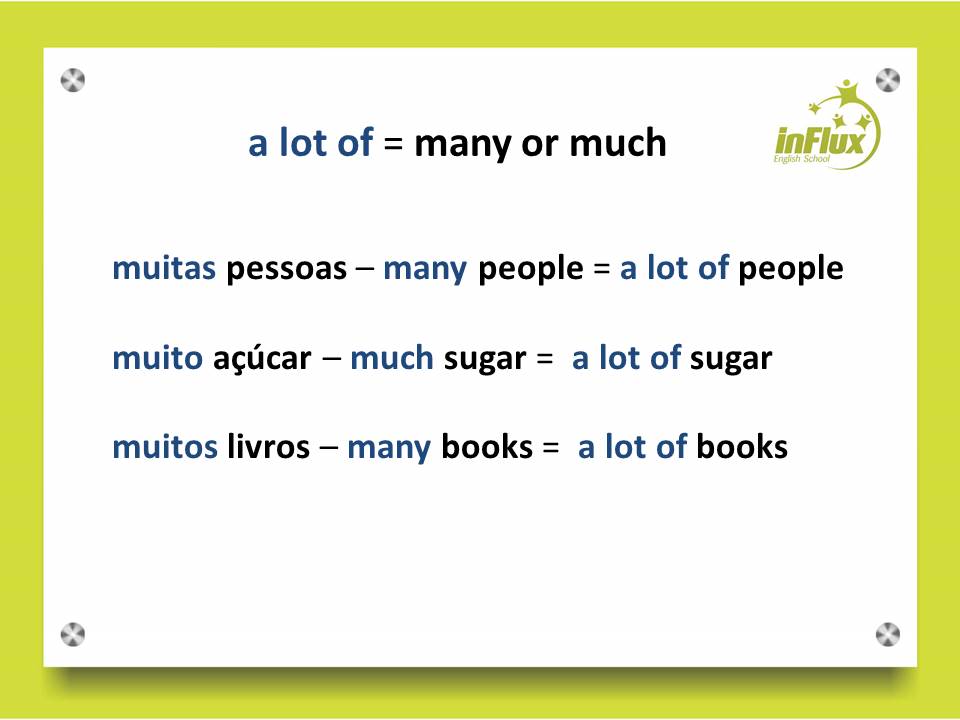
“Many”, “much” “a lot of” significam “muito(s)”“muita(s)”“bastante”. Vejam no quadro abaixo:

A lot of

Agora vamos ver alguns exemplos:

I have many books. Ou I have a lot of books.  Eu tenho muitos livros.

We don’t have much time. Ou We don’t have a lot of time.  Nós não temos muito tempo.

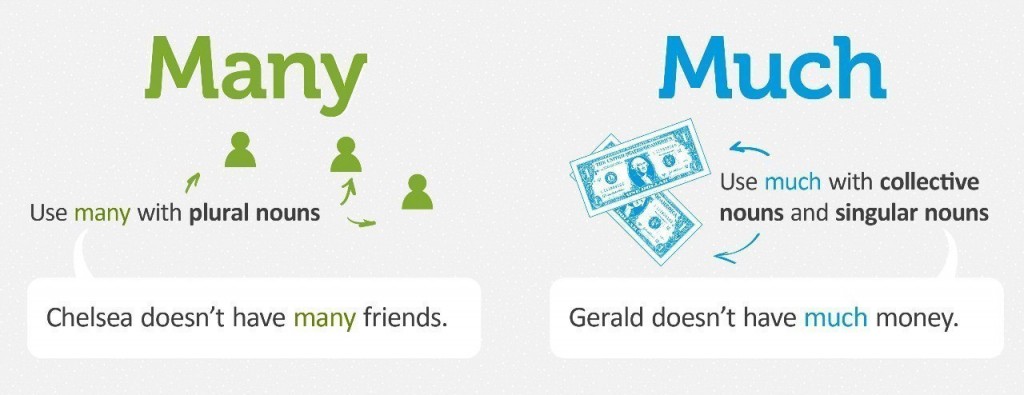
O significado é o mesmo, mas existe diferença quanto ao uso das expressões! “Many” e “much” são principalmente usadas em sentenças negativas ou interrogativas e são incomuns em sentenças afirmativas, sendo que “many” é usada com substantivos contáveis e “much” com substantivos incontáveis. Veja os exemplos:

I don’t have much money.  Eu não tenho muito dinheiro.

Do you have much money?  Você tem muito dinheiro?

She doesn’t have many friends.  Ela não tem muitos amigos.

Does she have many friends?   Ela tem muitos amigos?

many-much-1024x395

Nas sentenças afirmativas é muito mais comum usarmos “a lot of” ou sua forma mais informal: “lots of”. Vejam nas sentenças abaixo como ficariam com o uso de “a lot of”:

I have a lot of money ou I have lots of money.  Eu tenho muito dinheiro.

She has a lot of friends ou She has lots of friends.  Ela tem muitos amigos.

Vamos ao exercício?

1. There are ____________ books about English Learning in this store.

2. I don’t have ____________ homework to do.

3. ____________ students have doubts about the words “much” and “many”.

4. There were ____________ cars in the parking lot near the store.

5. I don’t drink ____________ milk in the morning.

6. There are ____________ apples on the kitchen table.

Procurem criar algumas sentenças usando estas expressões, e confiram as respostas do exercício aqui http://www.influx.com.br/blog/2011/11/27/quando-usar-many-e-much-respostas-exercicios-para-treinar-o-ingles/

Baseado em Denilso de Lima e Livia Bacan at: http://www.influx.com.br/blog/2009/03/12/many-much-e-a-lot-of/#sthash.IaLjzpvV.dpufehttp://www.influx.com.br/blog/2009/03/11/many-ou-much-e-agora/#sthash.JKKGvAot.dpufhttp://www.influx.com.br/blog/2011/11/26/quando-usar-many-e-much-exercicios-para-treinar-o-ingles/#sthash.YsrYWGME.dpuf

“My condolences…”

Existem algumas situações que não temos como evitar, e nessas situações, normalmente não sabemos como nos expressar. Normalmente dizemos “meus pêsames”, “meus sentimentos”, “minhas condolências” ou algo do gênero quando alguém conhecido perde um ente querido, certo? Portanto, é isso que vamos aprender hoje.

meus-pesames-img2

Caso queiram dizer meus pêsames ou minhas condolências para quem estiver de luto, em inglês, vocês dizem my condolences, como no exemplo abaixo:

 My condolences. Minhas condolências./ Meus pêsames.

I’m really sorry, my condolences. Eu lamento muito, minhas condolências.

I did not know your father had died. My condolencesEu não sabia que seu pai tinha morrido. Meus pêsames.

My condolences to you and your family on the passing of your father. Meus pêsames para você e sua família pelo falecimento de seu pai.

 Também é possível usar my deepest sympathies ou my sympathies quando queremos dizer “meus pêsames” ou “minhas condolências”.

My deepest sympathiesMeus pêsames/ Minhas condolências.

I’m so sorry, my deepest sympathiesEu lamento muito, meus pêsames.

He avoided her eyes and said “my deepest sympathies”. Ele evitou os olhos dela e disse “meus pêsames.

Também é possível dizer to offer (him) (your) deepest sympathies quando queremos dizer “dar (meus) pêsames/ (minhas) condolências (a ele)”Vejam alguns exemplos:

Meus pêsames2

My brother offered his sympathies to her. Meu irmão deu as condolências a ela.

He’s offering his sympathies to the familyEle está dando os pêsames à família.

You should offer him your deepest sympathiesVocê deveria dar seus pêsames / suas condolências para ele.

 by Felipe Tomass  http://blog.influx.com.br/como-dizer-meus-pesames-em-ingles

Pronunciation matters!

I’m a bit obsessed with pronunciation because of what I’ve experienced throughout all these years working with English, and how much it does influence communication! If the listener needs to guess what sound you’re trying to produce, it’s going to be harder for him to understand the ideas you’re trying to convey. You may think that is enough to make yourself understood! And it’s fine if your pronunciation is a bit off , but it’s not okay if they’re off by enough to make it hard for the listener to correctly process the sounds, and consequently understand what you’re talking about! We don’t need to sound exactly like native speakers, but we need to make sure that the words we produce can be clearly understood. We could say that our speech needs to be good enough to lead to phonemically accurate judgements by the listener.

So now the 100 most common English Tourism Industry words! Listen and practice!