Simple Present

Os verbos em inglês possuem três tempos verbais principais: passado, presente e futuro.

  • O passado é usado para descrever ações que já aconteceram
    (ex.: yesterday = ontem, last week = semana passada, three years ago = há três anos).
  • O futuro descreve ações que ainda vão acontecer
    (ex.: later = mais tarde, tomorrow = amanhã, next week = semana que vem).
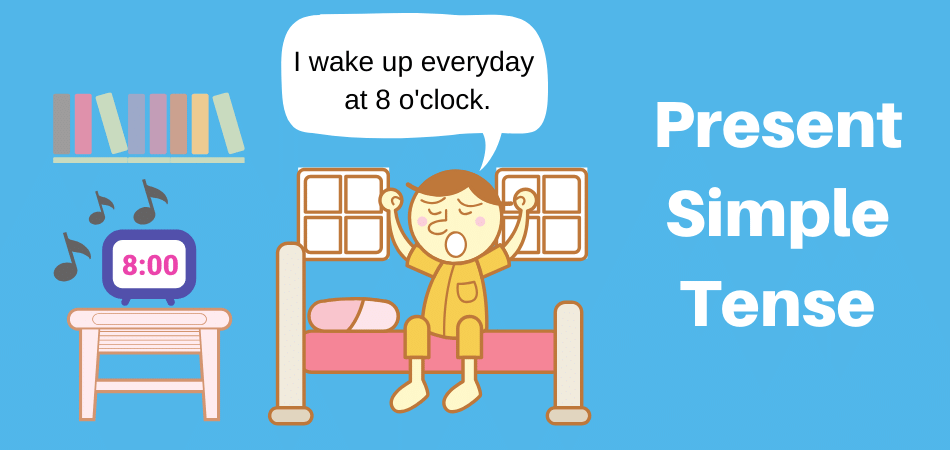
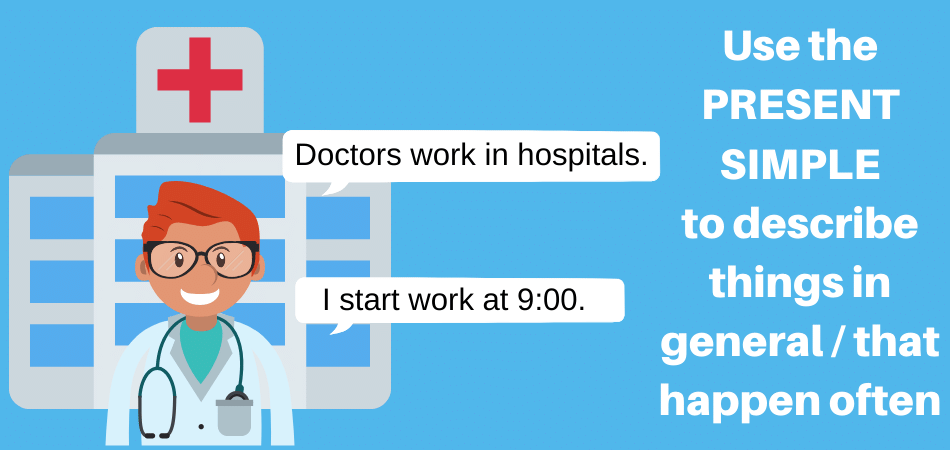
  • O presente simples é usado para falar de coisas em geral — ações que acontecem com frequência ou situações que são geralmente verdadeiras.

Doctors work in hospitals.
(Os médicos trabalham em hospitais.) — Verdade geral.

The doctor starts work at 9:00.
(O médico começa a trabalhar às 9h.) — Acontece sempre.


Conjugação: muito mais simples que em português!

Conjugar os verbos em inglês é bem mais simples do que em português.
Enquanto em português dizemos:

eu trabalho, você trabalha, ele trabalha, nós trabalhamos, vocês trabalham, eles trabalham,

em inglês, a conjugação no presente muda somente para he, she, it.

Vejam:

PessoaVerbo “work” (trabalhar)
Iwork
Youwork
He / She / Itworks
Wework
Youwork
Theywork

Como formar o presente simples

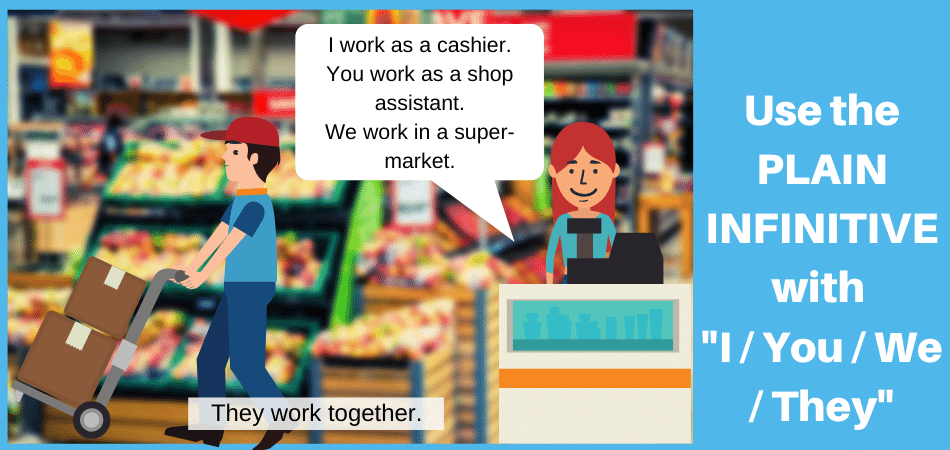
Usamos o infinitivo sem “to” (forma base do verbo) quando o sujeito é:
I (eu), you (você / vocês), we (nós) ou they (eles / elas).

Exemplos:

  • I work as a shop assistant. → Eu trabalho como atendente de loja.
  • You work as a cashier. → Você trabalha como caixa.
  • We work at weekends. → Nós trabalhamos nos fins de semana.
  • They work together. → Eles trabalham juntos.

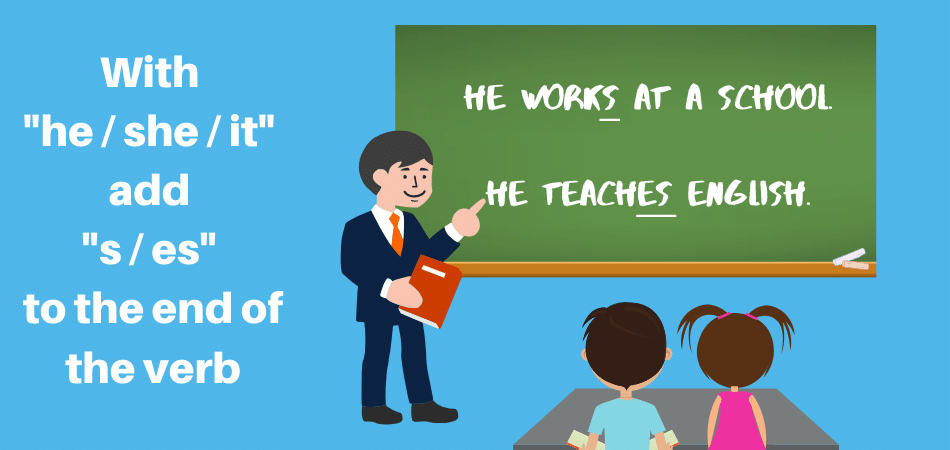
Para a 3ª pessoa do singularhe (ele), she (ela), it (ele/ela para coisas ou animais)acrescentamos “s” ou “es” ao verbo:

  • He works at a school. → Ele trabalha em uma escola.
  • He teaches English. → Ele ensina inglês.

Formas negativas e interrogativas

Nas frases negativas e interrogativas, usamos o verbo “do” como verbo auxiliar, junto com o verbo principal.

Quando o sujeito é he, she ou it, “do” muda para “does.”

Forma negativa

A estrutura é:
👉 Sujeito + do/does + not + verbo principal.
(Do/does not também pode ser abreviado para don’t/doesn’t.)

Exemplos:

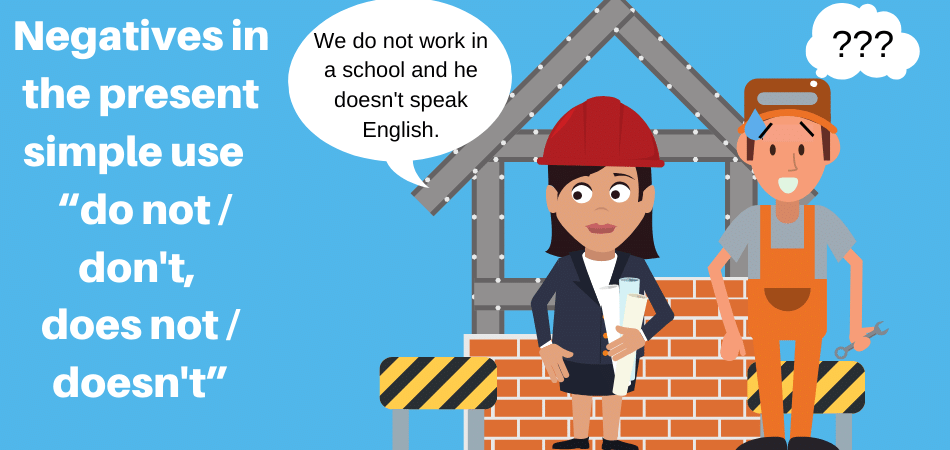
  • We do not work at a school. → Nós não trabalhamos em uma escola.
    (ou We don’t work at a school.)
  • He does not speak English. → Ele não fala inglês.
    (ou He doesn’t speak English.)

Forma interrogativa

Na pergunta, a ordem das palavras muda:
👉 Do/Does + sujeito + verbo principal + ?

Exemplos:

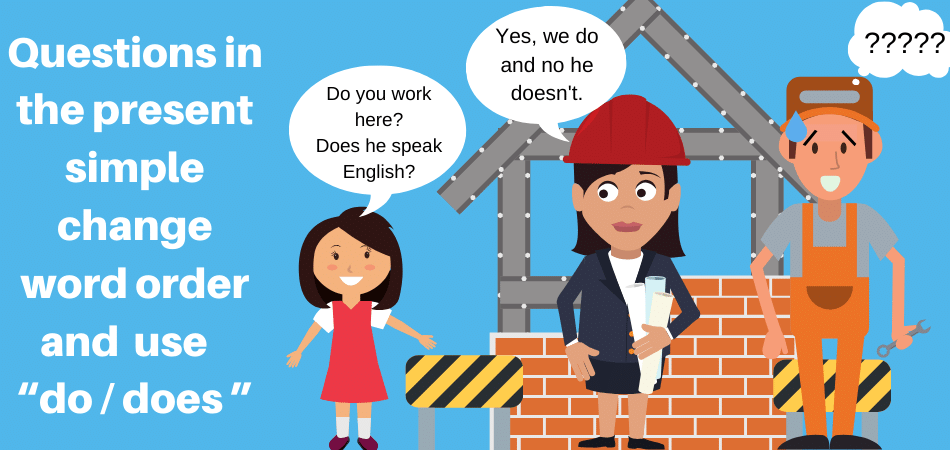
  • Do you work here? → Você trabalha aqui?
    Yes, we do. → Sim, trabalhamos.
  • Does he speak English? → Ele fala inglês?
    No, he doesn’t. → Não, ele não fala.

🟡 Atenção: Não usamos “do/does” em perguntas com o verbo to be (am, is, are) ou com verbos modais (can, might, must, etc.).


Verbo irregular “to have”

O verbo to have (ter) é irregular e muda na 3ª pessoa do singular:
👉 he / she / it has (em vez de have).

Este é um verbo muito comum e importante — fácil de aprender e fundamental para o uso do presente simples.


Agora, assista aos vídeo e pratique o que aprendeu! 🎬✨

Prática extra

Complete as frases com o verbo entre parênteses:

  1. My dad doesn’t work, but my mom ___________ a lot. (to work)
  2. He _________ to stay here. (to have)
  3. Carol _______________ to the gym every single day. (to go)
  4. I’m not OK with that, but my husband ____________ the idea. (to like)
  5. He ___________ his homework in the morning. (to do)
  6. She _____________ to read a book. (to prefer)
  7. The baby ___________ to eat. (to need)
  8. She ____________ to travel abroad. (to want)
  9. My son ______________ in the morning. (to study)
  10. Her daughter ______________ professionally. (to sing)
  11. His kid _____________ TV all day long! (to watch)
  12. She always _____________ to music. (to listen)

✅ Respostas:

1 – works
2 – has
3 – goes
4 – likes
5 – does
6 – prefers
7 – needs
8 – wants
9 – studies
10 – sings
11 – watches
12 – listens

Noun + Noun Combinations

What are they?

In English, we often use two nouns together to name something.
The first noun describes or gives more information about the second noun — it works like an adjective.

Example:

  • chocolate cake = a cake made with chocolate
  • car key = a key for a car

Word Order Difference

In Portuguese, we usually say:

X de Ybolo de chocolate

In English, we flip the order:

Y + Xchocolate cake

Think of it as “turning the phrase around.”


Examples by Category

TypePortugueseEnglishExplanation
Materialsapato de couroleather shoesshoes made of leather
Ingredientbolo de chocolatechocolate cakecake made with chocolate
Purposeescova de cabelohairbrusha brush used for hair
Contentcopo de vinhowine glassglass for wine
Placefazenda de cafécoffee farmfarm that produces coffee
Timereunião de domingoSunday meetingmeeting that happens on Sunday

Important Notes

✅ The first noun is usually singular, even when it refers to something plural:

  • a shoe store (not shoes store)

✅ If we use nouns that are always used in plural forms (such as shoes, glasses, gloves, etc.) as a modifier for another noun, we have to use them in the singular form:

  • His shoe size is 44.

Shoe is a singular form of the normally plural word shoes used to modify the noun size.

✅ Sometimes two nouns become a compound noun — a single concept that can be written as:

  • one word (toothbrush, toothpaste, bedroom, policeman)
  • two separate words (coffee cup, police station)
  • or hyphenated (mother-in-law, check-in, 15-year-old boy)

There’s no fixed rule for which form to use — it’s based on common usage.
👉 When in doubt, check a dictionary to see if it’s one word, two words, or hyphenated.


Common Mistakes for Portuguese Speakers

salad potato
potato salad

cup wine
wine cup or wine glass

The first noun always comes before the main noun and without “of”.
We only use “of” for possession or abstract ideas (the color of the sky, a friend of mine).


Press play and reinforce your learning!

Practice Time ✏️

A. Flip it!
Change from Portuguese-style order to English-style order:

  1. copo de água → ___________
  2. sapato de couro → ___________
  3. bolo de cenoura → ___________
  4. reunião de equipe → ___________
  5. história de amor → ___________

Answers:

  1. water glass
  2. leather shoes
  3. carrot cake
  4. team meeting
  5. love story

B. Complete the sentences:

  1. I need my ________ keys. (car)
  2. She’s wearing a beautiful ________ dress. (summer)
  3. We stayed in a small ________ house. (beach)
  4. This is my favorite ________ shop. (coffee)
  5. He bought a new ________ phone. (cell)

Answers:

  1. car keys
  2. summer dress
  3. beach house
  4. coffee shop
  5. cell phone

Quick Recap

👉 First noun = description (acts like an adjective)
👉 Second noun = main idea
👉 Formula: noun + noun → one concept
👉 In Portuguese: X de Y → In English: Y + X


💡 Tip for Learners

Try noticing these combinations when reading or listening to English — they’re everywhere!
Example: bus stop, flower shop, baby food, school bag, mountain view, etc.

-ED no Passado: Três Sons

No estudo do inglês, o ditado popular “ver para crer” precisa ser substituído por “ouvir para crer”.

Ouvir para Crer: O Caminho da Pronúncia em Inglês


1. Ortografia x Fonética

A relação entre escrita e som em inglês é muito diferente do português. A interpretação fonética da ortografia não segue um padrão único:

  • O mesmo grafema (letra ou grupo de letras) pode corresponder a diferentes fonemas (sons).
  • Uma mesma palavra pode ter pronúncia inesperada, se comparada à forma escrita.

2. A Irregularidade da Língua

Essa falta de correspondência regular entre ortografia e pronúncia faz com que a tentativa de “ler como se escreve” seja enganosa. Para quem não tem contato frequente com a língua falada, essa interferência da escrita pode criar vícios de pronúncia difíceis de corrigir.


3. O Desafio do Sufixo “-ed”

Um dos exemplos mais comuns desse problema é a pronúncia do sufixo “-ed”, que marca o passado dos verbos regulares.
Em português, tendemos a pronunciar todas as letras, mas em inglês o “-ed” tem três pronúncias possíveis:

  1. /t/ – quando o verbo termina em som surdo (p, k, f, s, ch, sh).
    • worked → /wɜːrkt/
    • kissed → /kɪst/
  2. /d/ – quando o verbo termina em som sonoro (vogais ou consoantes como b, g, l, m, n, r, v, z).
    • played → /pleɪd/
    • cleaned → /kliːnd/
  3. /ɪd/ – quando o verbo termina em som de /t/ ou /d/.
    • wanted → /ˈwɒntɪd/
    • needed → /ˈniːdɪd/

4. Recurso Prático

Para compreender e treinar a pronúncia correta, assista a estes dois vídeos selecionados. Eles explicam com clareza e demonstram, na prática, as três pronúncias do “-ed”.

👉 Dica prática: não leia o “-ed” como “édji” em todos os verbos. Escute, repita e associe cada grupo de sons.

✍️ Prática: Pronúncia do sufixo -ed

1. Classifique os verbos

Separe os verbos a seguir nos três grupos de pronúncia: /t/, /d/ ou /ɪd/.

  • wanted, washed, cleaned, needed, loved, kissed, played, watched, decided, worked, called, finished

2. Ouça e repita

(Leia em voz alta ou use um áudio)
Repita cada verbo prestando atenção no som final:

  • /t/ → worked, laughed, kissed
  • /d/ → played, cleaned, loved
  • /ɪd/ → wanted, needed, decided

3. Complete as frases

Coloque os verbos no passado. Depois, leia em voz alta com a pronúncia correta do -ed:

  1. Yesterday I ______ (play) soccer.
    (Ontem eu ______ futebol.)
  2. She ______ (wash) the dishes last night.
    (Ela ______ a louça ontem à noite.)
  3. They ______ (decide) to travel.
    (Eles ______ viajar.)
  4. We ______ (love) the movie.
    (Nós ______ o filme.)
  5. He ______ (need) help with the homework.
    (Ele ______ ajuda com a lição de casa.)

4. Desafio: Identifique a pronúncia

Leia as frases em voz alta e diga qual pronúncia o verbo no passado apresenta:

  1. I worked all day and finished late.
  2. She loved the surprise and called her friends.
  3. They wanted to travel but needed more money.

👉 Dica : diga primeiro o verbo no presente (work, play, want). Depois, acrescente o “-ed” de forma natural, sem tentar pronunciar cada letra isoladamente.


Phrasal Verbs

What Are Phrasal Verbs?

Phrasal verbs are a verb + one or more particles (prepositions or adverbs) that create a new meaning.
Example: get over = recover or overcome (not “get” + “over” literally).

They are very common in spoken English and often unpredictable.

Types of Phrasal Verbs

1. Two-Part Verbs

Verb + one particle

Examples:

  • grow upThe children are growing up.
  • take afterShe takes after her mother. (= She looks like her mother or she behaves like her mother.)
  • count onI can count on you. (= I know I can trust you or I know I can believe you.)

a) Inseparable

Verb and particle cannot be split.

She takes after her mother.

b) Separable

With a noun object, you may place the particle before or after the object:

She gave back the money. / She gave the money back.

But with a pronoun, separation is required:

She gave it back.
She gave back it.

Common separable particles: apart, around, away, back, behind, down, out, over, together, off, up.


2. Three-Part Verbs

Verb + two particles, always inseparable:

  • walk out onHis girlfriend walked out on him.
  • catch up withShe caught up with the runners.
  • look up toChildren should look up to their parents.

Grammar & Tenses

Only the verb changes form; the particles stay the same.

  • Past: I got over the flu.
  • Infinitive: I need to get over this cold.
  • Gerund: I’m getting over the flu.

Key takeaway:
A phrasal verb acts as one unit of meaning, so learn them as phrases, not word by word.

Practice

Test your knowledge of phrasal verbs with these online exercises.

Keep Learning

Want more? Watch the video for more phrasal verbs.

Talking About the Weather

🎯 Objectives

  • Learn common English adjectives to describe the weather.
  • Practice asking and answering: “What’s the weather like?”
  • Connect weather vocabulary to images, sounds, and real-life feelings.

🎥 Instructions

  1. Watch the video carefully.
    • Pay attention to the people describing the weather.
    • Listen to the audio and connect with images.

Dialogue Practice

Example 1

Chuck: It’s cloudy and damp.

Scene of clouds over a farmhouse with light rain.

📝 Damp = slightly wet.

Example 2

Diana: Brisk.
Dave: It’s brisk. It’s cool. Yeah.
Diana: Yeah, brisk. Wonderful.

📝 Brisk = invigorating; crisp; exhilarating.

Example 3

Steve: It’s a beautiful day in New York. It is cool and it is crisp. It is autumn.

A couple together in crisp air. Crisp means the same as brisk.

📝 Crisp = similar to brisk, refreshing air.

Example 4

Ghia: OK. Well, it’s really overcast and cloudy and it’s a bit crisp and a little windy. But it’s pleasant.

Overcast means cloudy, basically, so we see more clouds, but lower in the sky.

📝 Overcast = sky covered with clouds.

Example 5

Colin: Now? Dull and grey.
Chris: Cold.

Dull and grey here refers to the color rain and relative darkness.

📝 Dull and grey = dark, rainy, with no sunshine.

Example 6

Eric: Weather? Breezy. Bright. Sunny. Very nice. Very healthy.

We can tell it's breezy thanks to the arrows which indicate the direction of the wind, with a large sun for 'sunny'.

📝 Breezy = pleasantly windy.

Example 7

Minda: The weather is beautiful today. It’s a little cool. It’s dry and it is a little breezy and sunny.

The 3 weather adjectives are represented by 3 words, dry in the desert, with a big sun, and a lady with an umbrella about to break in the wind.

📝 Breezy = light wind. Windy = stronger wind.

Example 8

Sandra: It’s nice. It’s not too cold and it’s not too warm. It’s pleasant.

To illustrate the adjective 'pleasant' we have a man relaxing pleasantly in the sun with a thermometer showing pleasant temperatures.

Example 9

Anthony: Sunny. Mild. Not too hot. Not too cold.
📝 Mild = gentle, pleasant weather.

Example 10

Gabriella: Chilly. Windy.

Chilly: A man dressed warmly and for windy, a cloud figure blowing air.

📝 Chilly = almost cold.

Example 11

Peter: Cold and windy.

Icicles indicate it's cold.

Example 12

Lisa: Very sunny. Warm.

Just the sun shining brightly

Example 13

Stuart: Very cold. Windy. Not very nice.

Example 14

Paul: It’s raining.

A cloud releasing rain.

🔑 Key Vocabulary Recap

  • Damp = slightly wet
  • Brisk / Crisp = cool, invigorating
  • Overcast = very cloudy
  • Dull and grey = dark, rainy
  • Breezy = light wind
  • Windy = strong wind
  • Chilly = almost cold
  • Mild = pleasant, not extreme
  • Pleasant = nice, enjoyable

“What’s the weather like today where you are?”