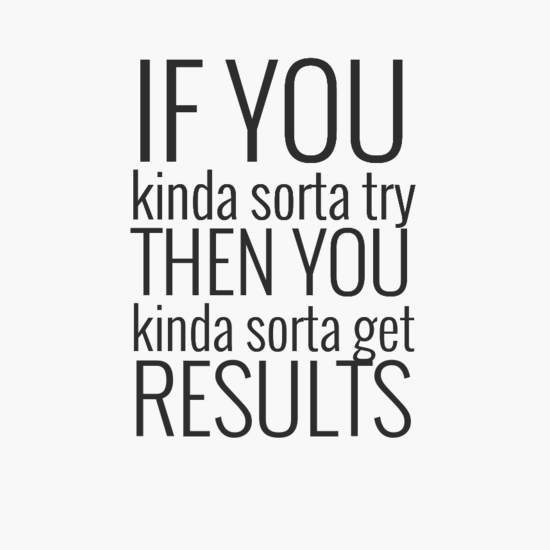
Hi everyone! The other day I used “kinda“ in a post, which was really appropriate. I think it’s about time for me to tell you what it means. Listen carefully to the following video.
Então, existem duas maneiras diferentes de usar estas palavras em inglês. A primeira é usar kind, sort e type quando você está falando sobre diferentes categorias ou grupos de coisas. E a segunda maneira de usar kind e sort (mas não type) é ao expressar incerteza sobre algo.
1. KIND OF, SORT OF, TYPE OF: CATEGORIAS OU GRUPOS
Essas palavras sempre vêm acompanhadas da preposição “of”: kind of,sort of, e type of . Exemplos:
1. What type of music do you like? (Que tipo de música você gosta?)
2. What are the different kinds of spices in this cake? (Quais são os diferentes tipos de condimentos desse bolo?)
3. That magazine prints fake news and all sorts of other rubbish. (Aquela revista publica notícias falsas e todo tipo de besteira.)
2. KINDA, SORTA: ESTABELECER INCERTEZA
Kind + of = kinda e sort + of = sorta. Essas palavras são usadas no geral para expressar a ideia de “um pouco” ou “meio”. Podemos também usá-las para estabelecer incerteza ou quando achamos que a nossa opinião poderá ofender alguém.
1. Mm, I’m kinda cold, could you please close the window? (Estou com um pouquinho de frio, você poderia fechar a janela?)
2. Do you like tomatoes? Mm, sorta. (Você gosta de tomates? Mais ou menos.)
3. “KINDA-SORTA”: MARCA DE UMA GERAÇÃO MAIS JOVEM
Essa expressão às vezes significa um pouco (1) e outras vezes muito (2). Também, pode mostrar indecisão (3) ou ser usada quando você está com preguiça (4). Independente da forma como é usada, essa expressão é muito popular hoje em dia, então é importante conhecê-la. Essa expressão é usada de diversas maneiras:
1. Who is that actor? / Oh, he used to be kinda-sorta famous back in the 90s. (Quem é aquele ator? / Ah, ele costumava ser um pouco famoso nos anos 90.)
2. How’s my writing paper? / Um, it still kinda-sorta needs some work. (Como está minha redação? / Hum, ainda precisa de muitas melhoras.)
3. So, are you guys, like, together? / Well, we’re kinda-sorta boyfriend/girlfriend. (Então, vocês dois estão, tipo, juntos? / Bem, nós somos meio que namorados.)
4. Do you wanna go out tonight? / Mm…kinda-sorta, not really, maybe, but yeah, okay. (Você quer sair hoje à noite? / Humm, mais ou menos, não muito, talvez, mas tá, ok.)
That’s it! Em que situações você usa kind, sort ou type na sua vida? Please, share it with me!
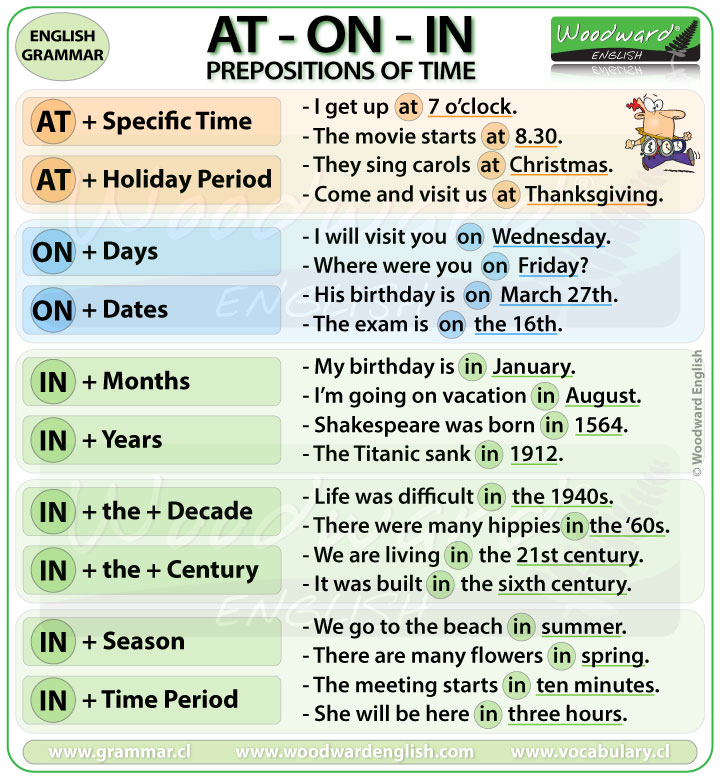
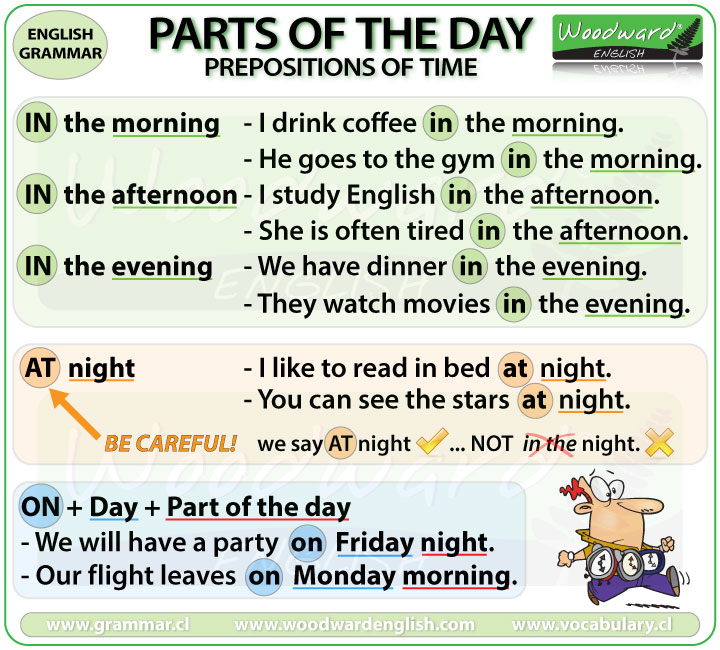
First, we learned a few basicprepositions of place. Next, we will look at IN, ON,and AT used to describe WHEN something happens, happened, and will happen.
AT
We use AT with specific times (hour / minutes):
I get up at 7 o’clock.
My English class starts at 10am.
She finishes work at 6.15.
I left the party at midnight.
Midnight (and midday) is a specific hour which is why we use AT.
12am = midnight 12pm = midday / noon
We use AT for a holiday period of two or more days:
Do you normally get together with your relatives at Christmas?
Did you eat a lot of chocolate at Easter?
ON
We use ON for specific days and dates:
I will return it to you on Wednesday.
They got married on Friday the 13th.
We get paid on the 20th of every month.
I drank too much milk on New Year’s eve.
Remember that for dates, we use ordinal numbers.
E.g. the First of September (not the one of September)
IN
We use IN for specific months, years, seasons, decades, centuries and lengths of time.
My birthday is in January. (I don’t mention the date, just the month)
My grandmother was born in 1927.
The river near my house is dry in summer.
Life was difficult in the 1940s.
The music was great in the eighties.
The company was founded in the 19th century.
We need to have this report ready in 15 minutes.
Compare:
The New Zealand National day is in February. (I don’t mention the day – only the month)
The New Zealand National day is on February 6th. (I mention the day – the order is not important)
The Weekend
Sometimes you will hear ATthe weekend and sometimes ON the weekend.
They are both correct. ON the weekend is used in United States.
Where did you go on the weekend? (American English)
Where did you go at the weekend? (British English)
At the moment
I don’t want to talk about it at the moment.
We don’t use Prepositions
We do not use AT, ON, IN, or THE before these words:
LAST, NEXT, THIS and EVERY
TODAY, TOMORROW, YESTERDAY, TONIGHT
The party is next Friday.
They went to the mountains last month.
Choose the correct alternative to complete the sentence.
Questions are quite tricky. Let’s just go over the main rules.
PRACTICE
Now watch the video and look at the examples of questions. They are in red in the subtitles. Transcribe the conversation to learn more. Read and study the information provided below, and finally, do the grammar exercises to check you understand and can use questions correctly.
We usually form questions by putting an auxiliary verb, or a modal verb, before the subject:
Does it suit me? Has Mum called? Can you get the tea? Shall I pass you to Oliver?
When the verb ‘to be’ is the main verb, we don’t use auxiliary verbs:
Is Oliver there? Was it good?
We can add question words to get more or different information:
Where did you go swimming? > In the swimming pool in town. Why did you go there? > Because it’s a nice, big pool. Who did you go swimming with? > With Amy. What time did you meet Amy? > At 10 o’clock. Which pool did you go in? > The serious one, without the slides! How did you get there? > On the bus.
Questions sometimes finish with prepositions:
Who were you out with? What have you got that bag for? What’s all that about? Where are you calling from?
SUBJECT AND OBJECT QUESTIONS
If who, what or which is the subject of the question, it comes before the verb and we don’t use do as an auxiliary:
Who went out for curry? (subject – who) What happened? (subject – what) Which looks better, this or that one? (subject – which)
Object questions follow the structure we looked at before:
Who did you go out for curry with? (subject – you; object – who) Which restaurant does Oliver like most? (subject – Oliver; object – which) What did they do after the restaurant? (subject – they; object – what)
TEST YOURSELF
Here’s a little test for you, then. A cat killed a mouse and a dog killed the cat.
1 What killed the mouse? 2 What did the cat kill? 3 What killed the cat? 4 What did the dog kill?
Answers: 1 the cat, 2 the mouse, 3 the dog, 4 the cat.
REPORTED SPEECH QUESTIONS
Reported speech questions are more polite, especially if you are talking to a stranger:
‘Do you know where the post office is?’
And we can make them even more polite.
‘Excuse me, could you tell me where the post office is, please?’
In reported speech or indirect questions, question words come in the middle of sentences. In these types of sentence, the word order does not change. We don’t put the verb to be before the subject or use an auxiliary to form a question, as in a normal question:
I asked her what she was doing at the weekend. Do you know where the post office is? Can you tell me how much it costs?
What are you doing at the weekend? Where is the post office? How much does it cost?
EXERCISES
1. Check your grammar – complete the gaps with a question word below.
What / Where / How / How often / When / Why / Who / Whose
1. A: ____________________ are you going on holiday? B: Next Friday.
2. A: ____________________ are you going? B: Croatia.
3. A: ____________________ bought the tickets? B: My mum did.
4. A: ____________________ do you go on holiday? B: Once every two years.
5. A: ____________________ don’t you go more often? B: Because we don’t want to.
6. A: ____________________ do you do the other years? B: We relax in the garden and visit friends.
7. A: ____________________ do you choose your holiday destination? B: We use the internet.
8. A: And ____________________ idea was it to go to Croatia? B: Our neighbours recommended it.
2. Check your grammar – circle the correct sentence.
1. a. What you have for lunch? b. What did you have for lunch? c. What had you for lunch?
2. a. Who is that letter from? b. From who is that letter? c. Who is from that letter?
3. a. She always sings in the shower? b. Sings she always in the shower? c. Does she always sing in the shower?
4. a. Can we go and visit Gran? b. We can go and visit Gran? c. Can go and visit Gran?
5. a. Who you bought those boots? b. Who bought you those boots? c. Who did buy you those boots?
6. a. Do you go to the cinema how often? b. How often do you go to the cinema? c. How often you go to the cinema?
7. a. What did he in Germany? b. What he did in Germany? c. What did he do in Germany?
8. a. Would you like another piece of cake? b. Do you would like another piece of cake? c. Do you like another piece of cake?
3. Check your grammar – ordering
Write the words in the correct order to make questions.
1. to Who were you ? talking …………………………………………………………………………………….…………………..
2. are at they ? looking What …………………………………………………………………………………….…………………..
3. music ? down the you Could turn …………………………………………………………………………………….…………………..
4. is for What homework the today ? …………………………………………………………………………………….…………………..
5. Who that photo ? took …………………………………………………………………………………….…………………..
6. match time does ? the start What …………………………………………………………………………………….…………………..
7. you How clean often ? do teeth your …………………………………………………………………………………….…………………..
1. Check your grammar: gap fill 1. When 2. Where 3. Who 4. How often 5. Why 6. What 7. How 8. whose
2. Check your grammar: multiple choice 1. b 2. a 3. c 4. a 5. b 6. b 7. c 8. a
3. Check your grammar: ordering 1. Who were you talking to? 2. What are they looking at? 3. Could you turn the music down? 4. What is the homework for today? 5. Who took that photo? 6. What time does the match start? 7. How often do you clean your teeth? 8. Why don’t polar bears eat penguins?