O present perfectsimple é utilizado para descrever algo que aconteceu no passado, e possui uma relação com o presente.
O tempo em que a ação ocorreu não é importante, por isso não é especificado.
Geralmente estamos mais interessados no resultado do que na própria ação.
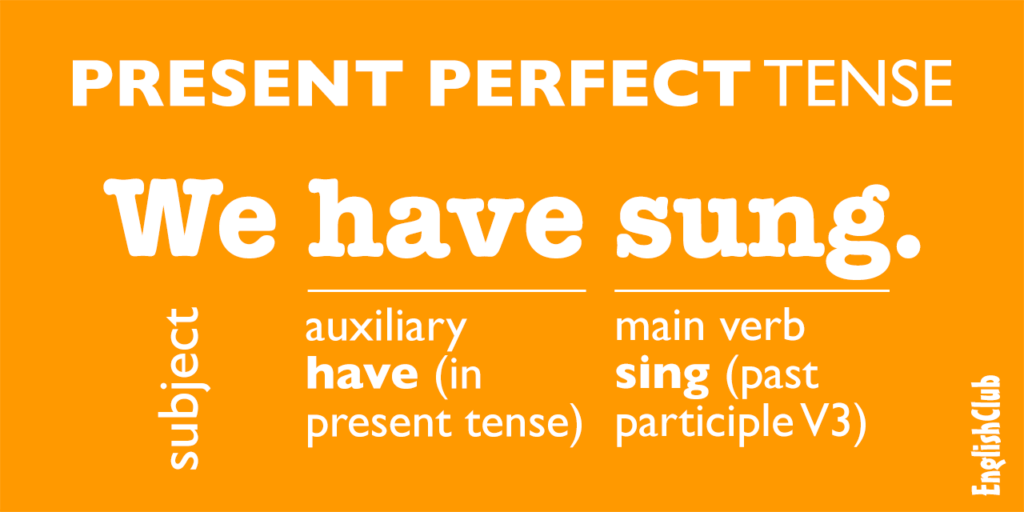
O present perfect de qualquer verbo é formado pela forma apropriada do verbo auxiliar to have (no presente) e o past participle do verbo principal.
Afirmativa: You have walked.
Negativa: You haven’t walked.
Interrogativa: Have you walked?
O present perfect é utilizado para descrever:
Uma ação ou situação iniciada no passado e que permanece no presente
I have lived in Bristol since 1984. (e continuo morando)
She has worked in the bank for five years. (e continua trabalhando)
Quando se faz referência a um período de tempo não concluído
She has been to the cinema twice this week. (e a semana ainda não acabou)
It has rained a lot this year. (e o ano ainda não acabou)
Ações repetidas em um período não específico entre o passado e o presente
We have visited Portugal several times.
She has visited them frequently.
Uma ação concluída, indicada pelos termos ‘already’, ‘just’ e ‘yet’.
Already indica ‘algo que aconteceu mais cedo do que o esperado‘:
The movie only came out yesterday, but I have already seen it.
Justsignifica ‘há pouco tempo atrás‘:
I have just finished my work.
Yet é usado apenas em perguntas e sentenças negativas. Refere-se a ‘algo que é esperado acontecer‘:
Have you finished the report yet? No, I haven’t finished it yet.
E quando o período exato da ação é irrelevante ou desconhecido
He has read ‘War and Peace’. (o resultado da leitura é importante)
Someone has eaten my soup! (não há sopa para mim)
Assista este vídeo, que mostra o caminho inverso, a visão de alguém aprendendo português: “O inglês e o espanhol têm este tempo verbal mas o português não, então para mim foi um desafio aprender como expressá-lo ao aprender português!”
Anote os exemplos, e veja onde eles se encaixam nas categorias mostradas acima.
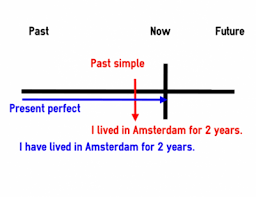
O diagrama seguinte, ilustra o intervalo de tempo envolvido na ação reportada através do present perfect, e o tempo definido na ação reportada através do simple past.
Verbs come in three tenses: present,past, and future.
The present tense is used to to talk about things in general. We can use it to describe actions that happen frequently or situations that are generally true.
The future tense describes things that have yet to happen (e.g., later, tomorrow, next week, next year, three years from now).
And the past tense.We use thepast tense to talk about an action which happened at a precise point in time and is completely finished (e.g., earlier in the day, yesterday, last week, three years ago).
Listen carefully to this video. Take notes.
In the present simple tense, we say:
I/you/we/they live …
BUT, for HE, SHE and IT, we add an S to the end of their verb in the present simple. So we say:
He/she/it lives …
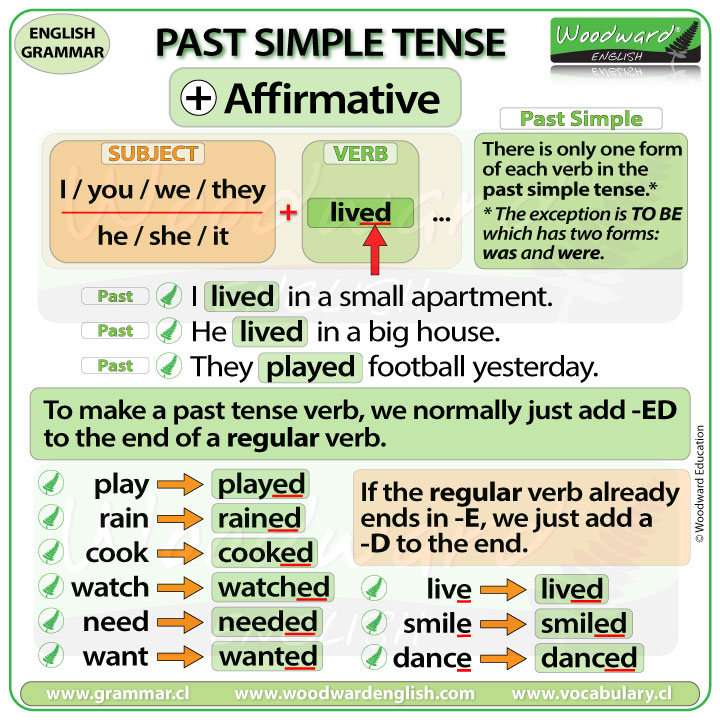
However, for the past simple tense it is much easier. There is only one form of each verb in the past simple tense.* * The exception is TO BE which has two forms: was and were.
The past tense of LIVE is LIVED. It is the same for all subjects including HE, SHE and IT. There is only one form for each verb.
I lived …
You lived …
We lived …
They lived …
He lived …
She lived …
It lived …
How do we make a past tense verb?
To make a past tense verb, we normally just add -ED to the end of a regular verb.
play becomes played
rain becomes rained
cook becomes cooked
watch becomes watched
need becomes needed
want becomes wanted
If the regular verb already ends in -E, we just add a -D to the end.
live becomes lived
smile becomes smiled
dance becomes danced
Let’s look at some more example sentences using regular verbs in the past simple tense:
I played my guitar yesterday.
It rained last night.
He fixed his bike last weekend.
Angela watched TV all night.
Paul wanted to go to the museum.
How do we make a negative sentence in the past simple tense?
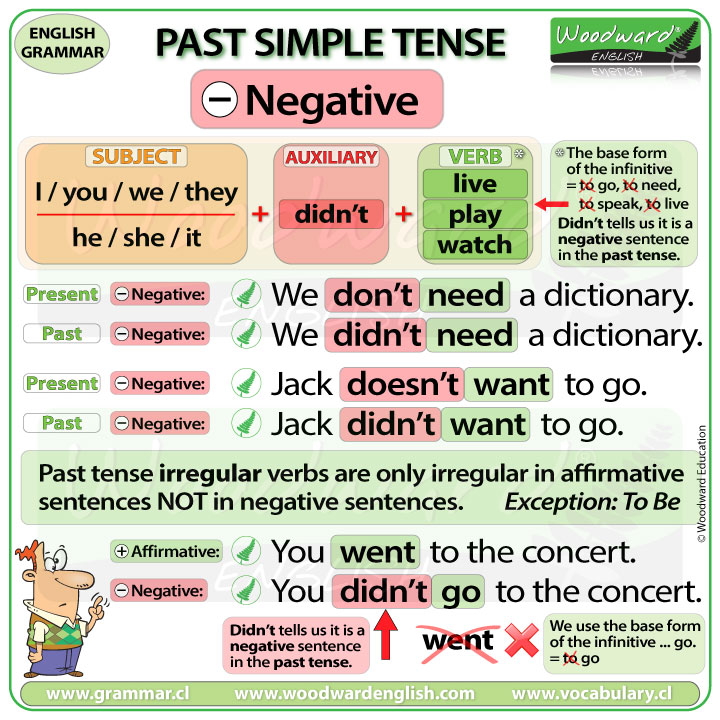
Didn’t is used to make negative sentences in the past simple tense.
They lived in Spain … becomes …
They didn’t live in Spain.
We do not say they didn’t lived in Spain. No!
Remember, in the present simple tense, don’t and doesn’t are used. In the past simple tense, we only have one auxiliary: didn’t.
I didn’t, you didn’t, we didn’t, they didn’t, he didn’t, she didn’t, it didn’t.
The verb after didn’t is always the base form of the infinitive. didn’t live … didn’t play… didn’t watch
Some more examples of negative sentences in the past simple tense:
I didn’t want to go home.
You didn’t need my help.
He didn’t like the soup.
She didn’t open the door.
We didn’t say anything.
They didn’t drive to work.
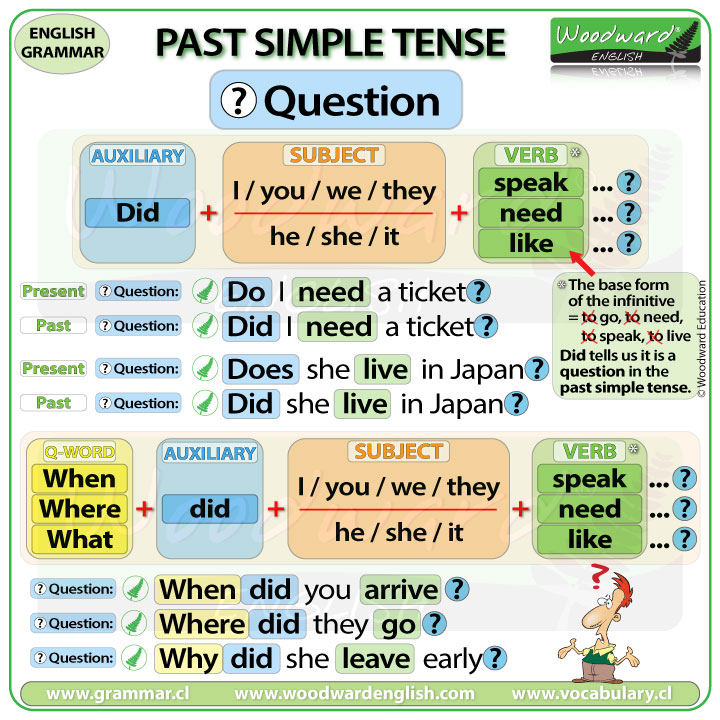
But how do we make a question in the past simple tense?
We use DID to make questions in the past simple tense.* * Exceptions: Questions with To Be or Modal Verbs (can, might, must, etc.)
They lived in Spain … becomes …
Did they live in Spain?
Notice how we use the base form of the infinitive, just like with negative sentences. We do not say: Did they lived in Spain? No!
Some more examples of questions in the past simple tense:
Did I win the prize?
Did you need my help?
Did he like the soup?
Did she open the window?
Did we arrive on time?
Did Steve walk to school?
Short Answers in the Past Simple Tense
With questions beginning with DID, you can often give a short answer.
Look at these questions. What are some possible short answers?
Did you need my help? Yes, I did … or … No, I didn’t.
Did she open the window? Yes, she did … or … No, she didn’t.
NOT IN VIDEO: Did we win the game? Yes, we did … or … No, we didn’t.
Did Steve walk to work? Yes, he did … or … No, he didn’t.
Question Words in the Past Simple Tense
With questions, you can also use one of the “question words” such as when, where, why, what, who, which etc. before DID. Look at these example questions:
Whendid you arrive?
Wheredid they go?
Whydid she leave early?
Whatdid he say?
Whodid you see?
Whichdid you choose?
Howdid you learn English?
Past Simple Tense – Irregular Verbs – Affirmative Sentences
Let’s look at the verb TO GO. In the present tense it is GO or GOES. The past tense of GO is WENT. WENT is used for all subjects…
I went, you went, he went, she went, it went, we went, and they went.
They all use WENT. For example:
I went to the beach last weekend.
She went to the dentist last week.
They went to the library yesterday.
You went to a concert last night.
Past Simple Tense – Irregular Verbs – Negative Sentences
For negative sentences in the past tense, we follow the same rules as regular verbs.
We use didn’t with the verb in its base form. For example:
You went to the concert.
You didn’tgo to the concert.
Notice how we use just GO instead of TO GO.
We don’t say: You didn’t went to the concert. No!
Past Simple Tense – Irregular Verbs – Questions
We use DID at the beginning while the verb is in the base form of the infinitive.
Did you go to the concert?
Notice how we use just GO instead of TO GO.
We don’t say: Did you went to the concert? No!
Past Simple Tense – Irregular Verbs – Summary
So basically, past tense irregular verbs are only irregular in affirmative sentences. AND there is only one form for each verb. For example:
You went to the concert.
You didn’t go to the concert.
Did you go to the concert?
You can see that GO is only irregular in affirmative past tense sentences when it becomes WENT. In negative sentences and questions, we use GO.
O simples uso, troca, de uma palavra do português pelo seu equivalente em inglês, num número grande de vezes, resulta em algo que não faz sentido algum.
O contrário é igualmente verdadeiro. Portanto, enfatizo a experiência com pedaços, chuncks, conjuntos, combinações de palavras, e ainda contextualizadas, para uma correta apropriação e uso delas.
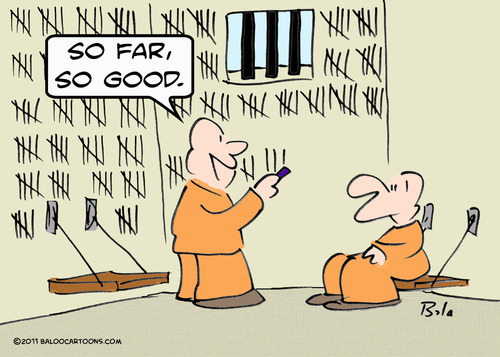
So far, so good não significa tão longe, tão bom. Significa: por enquanto tudo bem; até agora tudo certo, até aqui tudo bem.
I’ve done half of my homework, so far, so good.
Eu já fiz metade da minha lição de casa, até aqui tudo bem.
How is the new project coming along? Como está o andamento do novo projeto? Well; so far, so good. Bem, até agora tudo certo.
So far, so good. We got to the airport on time.
Até agora, deu tudo certo. Nós chegamos ao aeroporto na hora certa.
Do you guys have any questions?Vocês têm alguma dúvida? No, teacher. So far, so good. Não, professor. Até aqui tudo bem.
How’s the surgery going? So far, so good. Como está indo a cirurgia? Até agora tudo bem.
Especially means ‘in particular’, ‘particularly’, or ‘most of all’. We use especially to show that what you are saying applies more to one thing or situation than to others.
I like food, but I especially like sandwiches.
He’s often a little late, but he was especially late today.
She looked especially beautiful that night.
I like all of my friends, especiallyMark.
All of the rooms are dirty, especiallythe bathroom.
Our baby cries a lot, especiallywhen he is hungry.
Dave and Mark like football. Dave,especially, watches lots of matches on TV.
Mark: Do you want to live abroad? Jane: Yes, I would especially like to live in France.
When especially relates to the subject of a sentence, you put it immediately after the subject.
Young babies, especially, are vulnerable to colds.
You can also use especially in front of an adjective to emphasize a characteristic or quality.
I found her laugh especially annoying.
We use specially to say that something is done or made for a particular purpose.
This sandwich was specially made.
They had a chair specially designed for her size.
The animals are specially trained to locate the mushrooms.
I bought a bag specially for my computer.
The suit was specially made for me.
I went to New York specially to see the Statue of Liberty.
We can use both, especially and specially, when we refer to a ‘special purpose,’ or ‘specifically.’
I bought this milk especially / specially for you.
The speech was written especially / specially for the occasion.
Practice doing the mini-testat the end of the page.
But after you are comfortable enough with basic vocabulary, it is important to push yourself to the next level and learn how to express yourself in other ways like: How are you, How’s it going, How have you been, and many others.
After all, English language speakers have many different ways of saying the same (or similar) things.
Let’s expand beyond the American-British English scope and learn how Aussies, people from Australia, greet someone.