Alguns aprendizes da língua inglesa, estão precisando rever isto! So here it goes!
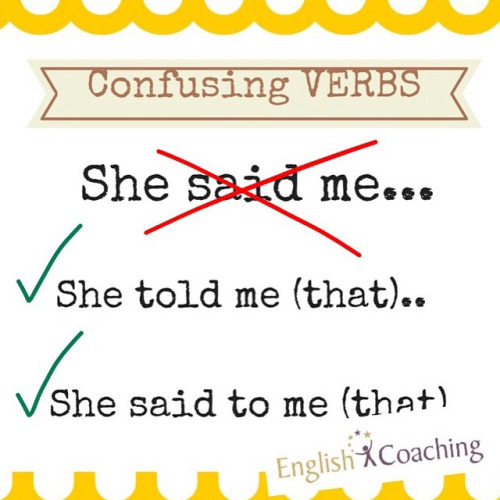
Quando queremos dizer que alguém falou ou disse algo, podemos usar dois verbos: say e tell. Esses verbos, têm significado semelhante, mas não são iguais.
O verbo tell é utilizado quando os dois participantes da conversa estão incluídos. Então, you
TELL SOMEBODY SOMETHING
Mary told me she was in the hospital. [A Mary me disse que ela estava no hospital.]
He told me (that) he was tired. [Ele me disse que estava cansado.] Tell me what’s going on! [Me diga o que está acontecendo!]
Já o verbo say, apresenta apenas um participante da conversa. You
SAY SOMETHING
Mary said (that) she was in the hospital. [A Mary disse que ela estava no hospital.]
He said (that) he was tired. [Ele falou que estava cansado.]
She said (that) blue is her favorite color. [Ela disse que azul é a cor favorita dela.]
No entanto, podemos incluir os dois participantes da conversa, se usarmos say to. Então you
SAY SOMETHING TO SOMEBODY
That’s what I said to him. [Foi isso que eu disse a ele.]
De qualquer maneira, o verbo tell é muito mais comum nessas situações do que o say to.
Também usamos o tell quando nos referimos a “contar uma história” [tell a story], “contar uma piada” [tell a joke], “contar uma mentira”,[tell a lie], “contar a verdade” [tell the truth], “contar um segredo” [tell a secret].
Grandpa always tells us his stories. [O vovô sempre nos conta suas histórias.]
Tell him the truth. [Conte a verdade a ele.]
I’m going to tell you a joke. [Vou te contar uma piada.]
Got it? So tell me if you got it and check tomorrow’s Blog post for exercises!
I’m a bit obsessed with pronunciation because of what I’ve experienced throughout all these years working with English, and how much it does influence communication! If the listener needs to guess what sound you’re trying to produce, it’s going to be harder for him to understand the ideas you’re trying to convey. You may think that it’s enough to make yourself understood… And it’s fine if your pronunciation is a bit off , but it’s not okay if they’re off by enough to make it hard for the listener to correctly process the sounds, and consequently understand what you’re talking about! We don’t need to sound exactly like native speakers, but we need to make sure that the words we produce can be clearly understood. We could say that our speech needs to be good enough to lead to phonemically accurate judgement by the listener.