
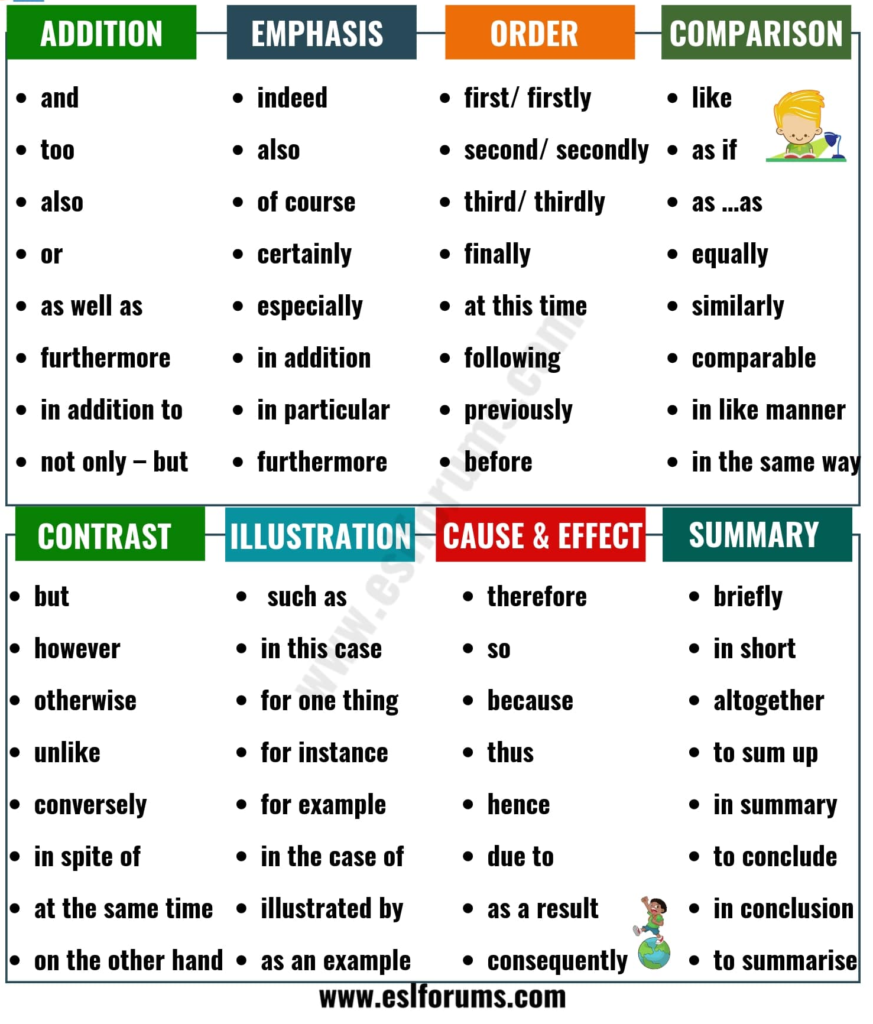
Linking words help you to connect ideas and sentences when you speak or write in English. They develop coherence within a paragraph, that is showing relationships, linking one idea / argument to another.
We can use linking words, also known as transitions words or conjunctions, to give examples, add and sequence information, summarise, give a reason or result, or to contrast ideas.
Giving examples
For example
For instance
Namely
The most common way to give examples is by using for example or for instance.
Namely refers to something by name.
“There are two problems: namely, the expense and the time.”
Adding information
And
In addition
As well as
Also
Too
Furthermore
Moreover
Apart from
In addition to
Besides
Ideas are often linked by and. In a list, you put a comma between each item, but not before and.
“We discussed training, education and the budget.”
Also is used to add an extra idea or emphasis. “We also spoke about marketing.”
You can use also with not only to give emphasis.
“We are concerned not only by the costs, but also by the competition.”
We don’t usually start a sentence with also. If you want to start a sentence with a phrase that means also, you can use In addition, or In addition to this…
As well as can be used at the beginning or the middle of a sentence.
“As well as the costs, we are concerned by the competition.”
“We are interested in costs as well as the competition.”
Too goes either at the end of the sentence, or after the subject and means as well.
“They were concerned too.”
“I, too, was concerned.”
Apart from and besides are often used to mean as well as, or in addition to.
“Apart from Rover, we are the largest sports car manufacturer.”
“Besides Rover, we are the largest sports car manufacturer.”
Moreover and furthermore add extra information to the point you are making.
“Marketing plans give us an idea of the potential market. Moreover, they tell us about the competition.”
Summarising
In short
In brief
In summary
To summarise
In a nutshell
To conclude
In conclusion
We normally use these words at the beginning of the sentence to give a summary of what we have said or written.
Sequencing ideas
The former, … the latter
Firstly, secondly, finally
The first point is
Lastly
The following
The former and the latter are useful when you want to refer to one of two points.
“Marketing and finance are both covered in the course. The former is studied in the first term and the latter is studied in the final term.”
Firstly, … secondly, … finally (or lastly) are useful ways to list ideas.
It’s rare to use “fourthly”, or “fifthly”. Instead, try the first point, the second point, the third point and so on.
The following is a good way of starting a list.
“The following people have been chosen to go on the training course: N Peters, C Jones and A Owen.”
Giving a reason
Due to / due to the fact that
Owing to / owing to the fact that
Because
Because of
Since
As
Due to and owing to must be followed by a noun.
“Due to the rise in oil prices, the inflation rate rose by 1.25%.”
“Owing to the demand, we are unable to supply all items within 2 weeks.”
If you want to follow these words with a clause (a subject, verb and object), you must follow the words with the fact that.
“Due to the fact that oil prices have risen, the inflation rate has gone up by 1%25.”
“Owing to the fact that the workers have gone on strike, the company has been unable to fulfill all its orders.”
Because / because of
Because of is followed by a noun.
“Because of bad weather, the football match was postponed.”
Because can be used at the beginning or in the middle of a sentence. For example, “Because it was raining, the match was postponed.”
“We believe in incentive schemes, because we want our employees to be more productive.”
Since / as
Since and as mean because.
“Since the company is expanding, we need to hire more staff.”
As the company is expanding, we need to hire more staff.”
Giving a result
Therefore
So
Consequently
This means that
As a result
Therefore, so, consequently and as a result are all used in a similar way.
“The company are expanding. Therefore / So / Consequently / As a result, they are taking on extra staff.”
So is more informal.
Contrasting ideas
But
However
Although / even though
Despite / despite the fact that
In spite of / in spite of the fact that
Nevertheless
Nonetheless
While
Whereas
Unlike
In theory… in practice…
But is more informal than however. It is not normally used at the beginning of a sentence.
“He works hard, but he doesn’t earn much.”
“He works hard. However, he doesn’t earn much.”
Although, despite and in spite of introduce an idea of contrast. With these words, you must have two halves of a sentence.
“Although it was cold, she went out in shorts.”
“In spite of the cold, she went out in shorts.”
Despite and in spite of are used in the same way as due to and owing to. They must be followed by a noun. If you want to follow them with a noun and a verb, you must use the fact that.
“Despite the fact that the company was doing badly, they took on extra employees.”
Nevertheless and nonetheless mean in spite of that or anyway.
“The sea was cold, but he went swimming nevertheless.” (In spite of the fact that it was cold.)
“The company is doing well. Nonetheless, they aren’t going to expand this year.”
While, whereas and unlike are used to show how two things are different from each other.
“While my sister has blue eyes, mine are brown.”
“Taxes have gone up, whereas social security contributions have gone down.”
“Unlike in the UK, the USA has cheap petrol.”
In theory… in practice… show an unexpected result.
“In theory, teachers should prepare for lessons, but in practice, they often don’t have enough time.”
Okay! Did you enjoy everything you’ve learned? Now practice here. 😉